A prayer for the beaches of Gaza

by Ruth Goring

Before the ruin
when the sea was green breaking to white
and children chased each other
when the sun was life
and they picnicked: olives, hummus, bread

After the ruin
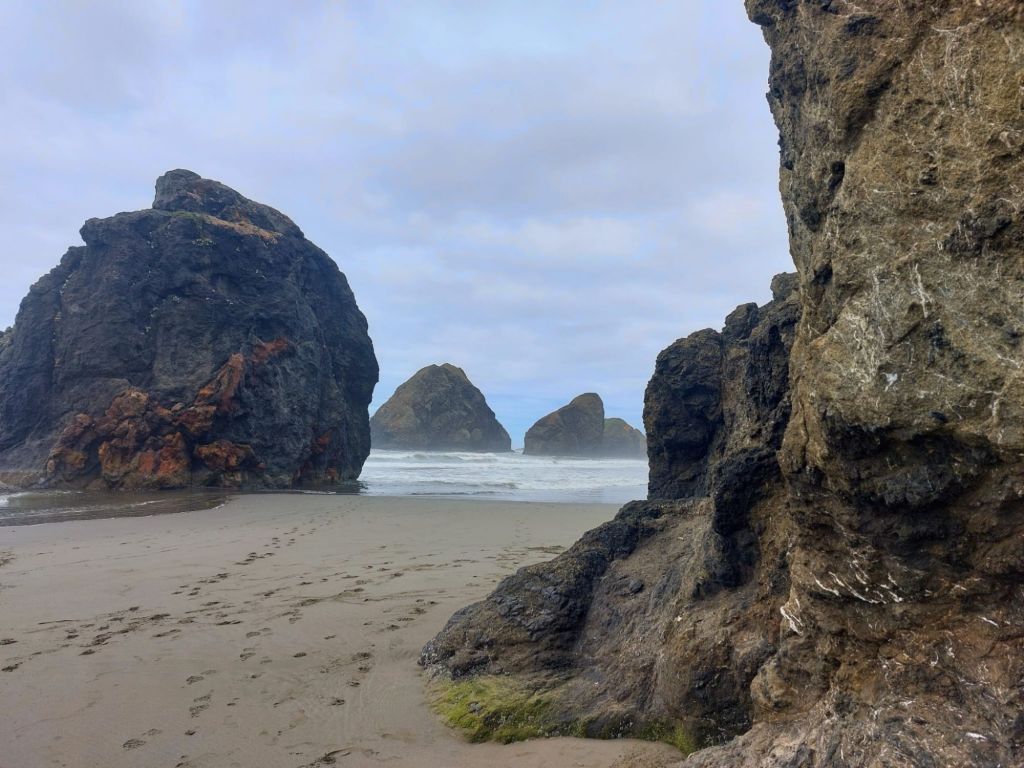
with my sister I walk among giants of rock
on the south coast of Oregon
Angels, old and black,
chant their subduction
the clash of volcanoes, islands
and small continents shoved up against
the continental plate

In Gaza the ruin has not ended
With no thought of beaches
hounded children crouch in tents
Their parents seek just a little flour
for bread

Dear angels of subduction
we set our hands on your vast shoulders
we ask for your strength
we pray against ruin

Before we rose, in the daylight of Gaza
bombs rained on the camps
and demolished demolished
one father, four children in a tent

One mother is left
and she has no feet

What is this world
What is this crashing
What raided the house of our belonging
left doors swinging on broken hinges
What suffocates us all
What ruin

Dear sentinels, dear Old Ones
we are not strong like you
we need our feet
we need gentleness and food
Dear God in heaven
come to the beaches of Gaza
and the tents, come now

Tell us
how we live in this bombing
or far away from it
with helpless hands

I walk out to one of the giants
lean against its ancient bulk
A wave rolls in over my feet
How do I live

Moral injury

An open letter to US elected officials

On the sad anniversary of Israel’s intensified attacks on Gaza, recognized around the world as a genocidal campaign but supported unconditionally by my own government, I have written a letter that I will be posting in the following online forms. If you feel moral injury as I do, you are welcome to copy and adapt this letter to share with your own electeds. Here are sites for my representatives, along with links you can use to communicate with yours:

President Biden: https://www.whitehouse.gov/contact/share/

Vice President Harris: https://www.whitehouse.gov/contact/vicepresident/

Senator Richard Durbin: https://www.durbin.senate.gov/contact/email

Senator Tammy Duckworth: https://www.duckworth.senate.gov/connect/email-tammy

Representative Jan Schakowsky: https://schakowsky.house.gov/zip_authentication?form=/contact/email-me

Find your senators: https://www.senate.gov/senators/senators-contact.htm

Find your congressperson: https://www.house.gov/representatives/find-your-representative

Dear President Biden, Vice President Harris, Senator Durbin, Senator Duckworth, Representative Schakowsky:

The Earth has made a complete orbit around the Sun since October 2023, and thanks to all of you, the world has been witnessing the first genocide of the twenty-first century during these twelve months.

  • You did not acknowledge that Hamas’s incursion into Israel on October 7, 2023, was inevitable given the cruel and unrelenting blockade of movement and resources that Israel had maintained over Gaza for many years.
  • As Israel began carrying out its revenge and targeting the civilians of Gaza, you seized the opportunity to assist it with countless lethal weapons, including 2,000lb bombs, which it has used to incinerate refugee camps, killing whole families, and has dropped on other homes and on schools, universities, churches, mosques, markets, and farms. It has targeted water plants and left people drinking fetid water from puddles and ditches. It has committed one war crime after another. Its snipers have gleefully targeted older women like me, its snipers have shot children in the head. Its soldiers film themselves laughing while they humiliate prisoners. These videos have been posted on social media for the whole world to see.
  • You have wrinkled your faces in expressions of empathy and urged Israel to minimize civilian casualties and investigate a couple of the many reported incidents of human rights abuses. You know full well that Israel will not investigate its misdeeds honestly.
  • While supposedly waging this assault in the name of freeing the hostages held by Hamas, Israel has killed a number of those hostages, again with US weapons.
  • About a dozen employees of UNRWA were accused of participating in the October 7 raid or supporting it some way. UNRWA promptly fired those employees. But instead of lauding its quick response, you cut off support for UNRWA, the only source of food for thousands of Gazans, and you influenced other Western governments to do likewise. With trucks carrying aid blocked by Israeli soldiers and settlers at all the crossings, the people of Gaza who have not been killed are starving. They walk the streets like ghosts.
  • Rep. Schakowsky, months ago you justified voting for a bill that included another huge sale of weapons to Israel with a long statement arguing that it was the only way to get desperately needed food aid to Gaza. Do you not understand that dropping boxes of food is stupendously offensive when you have also provided Gaza’s enemy with massive weapons and artillery to kill those hungry people?
  • President Biden and Vice President Harris, you claim to be working “tirelessly” for a ceasefire. Surely you are aware that Hamas is not the one putting up obstacles to a ceasefire agreement. It has agreed multiple times to US-backed proposals. Netanyahu’s government is the intransigent party every time. Indeed Israel sent assassins to kill Hamas’s chief negotiator, Ismail Haniyeh, in Tehran. Netanyahu knows that his administration will fall apart if he says yes to a cessation of hostilities. And he has absolutely no positive reason to say yes, given that the United States continues to blithely send weapons at the rate of two shipments every single day.
  • You are violating multiple US laws each time you send those weapons to Israel. We are under obligation to stop arming any country that commits human rights abuses in its conduct of war. But somehow you see yourselves as above this law.
  • Emboldened by your encouraging words (“we will never abandon Israel”), Israel has increased its violence in the West Bank. And now Lebanon, Yemen, Iran, Syria . . .

I am deeply ashamed of you as representatives of the country where I vote and pay taxes. You seem blissfully unaware that as you enable the destruction of Gaza and its people, you are also inflicting profound moral injury on the people whom you were elected to serve and represent. Moral injury happens when great evil is done in our name and we are powerless to stop it. The people of the United States do not approve of your support of Israel’s carnage, and we have been letting you know in polls, petitions, phone messages, street protests. But you do not listen to us. In this election season you are probably glad to be running against Trump and all the Project 2025 people, because their plans are so horrific that when we shut our eyes to Gaza, you seem like the good guys. But we know. Even ardent Democrats know that you are injuring us as you wrap yourselves in the Israeli flag. You are injuring the whole world.

Do you remember Aaron Bushnell, the Air Force serviceman who immolated himself in front of the Israeli embassy last February, crying out “Free Palestine”? Did you dismiss his agony because he wasn’t your constituent? Aaron saw your complicity in genocide—a complicity that we all share as taxpayers. You are using our money and you are killing our souls as you arm Israel so that it can starve, torture, and kill the people of Palestine.

I am seventy years old, a mother and grandmother, an artist and writer, a follower of Jesus. I live very modestly but have a rich and beautiful life. And on this anniversary I am contemplating Aaron Bushnell’s action. I am wounded by what you are doing in my name, and I’m wondering what desperate public step I could take to wake you up.

You probably wouldn’t care much because I don’t donate to your campaigns. And since you can see the images of Gazan babies killed by US bombs and you keep sending the bombs anyway, you wouldn’t be moved by any sacrifice I might make. You have political reasons that completely override public or personal ethics.

It is exhausting and heartbreaking to live in the world that you are destroying. But I believe that somewhere in your core, you, like me and like every human being, still have a soul that longs for God and reaches for the good. Will you begin to shut out the political pressures and listen to your own soul? Are you able to reverse course—to repent, to use an apt biblical term? You don’t have to stop being a politician: you could actually start listening to your constituents and help to assuage our moral injury. You could uphold US law and impose an arms embargo. You could save dollars that way and direct them toward reparations for the people of Gaza and meeting urgent needs for healthcare, education, and housing here in the USA.

You could. Will you?

In grief and necessary hope,

Ruth Goring

Chicago police gathered around me in June 2024 as I lay shrouded on Franklin Street in front of the building where AIPAC has its local office. Along with ten others, I chose arrest and jail in order to make vivid the deadly consequences for Gaza of our country’s unethical Middle East policies.

Photo by Michael Bracey.

Rocks & drips: Colombia Chronicles 2

In July I was privileged to tour Medellín’s Moravia neighborhood, constructed over a city dump. The original residents were garbage pickers, & some of them still live there. The dump itself has been built up into a grassy park with flower plantings, a large greenhouse (for flowers only, as the soil is too toxic to grow healthy vegetables/fruits), & a historical walking route with photo markers telling the community’s story.

(a) It’s a rather strenuous climb! (b) Images of the original dump. (c) Hillside garden. (d) The neighborhood is colorfully charming nowadays, though there’s still lots of poverty.

I was taken to visit a couple of preschools where children had heard & discussed Los ángeles de Adriana, my picture book about a Colombian refugee child & the guardian angels who accompany her. The Mama Chila school, named for its founder, was an incredibly inviting space. For my session with the children, the staff decorated with rocks because many of the kids were taken with the symbol of mean words as sharp little stones that “rattle around and hurt.”

preschool stones Moravia

Slips of paper were placed over some of the rocks. They bore quotes from the kids themselves:

  • The angels always accompany the little girl, because she can’t take care of herself alone.—Jampool (try pronouncing that in Spanish, but with an English-style J; you’ll realize that he’s named for a former pope!)
  • The rocks came into her from the children who didn’t want to play with her.—Dylan
  • I didn’t like the children who were treating Adriana badly, because they weren’t respecting her and their parents didn’t teach them to be kind.—Isis
  • Adriana’s angels always stay with her and help her to sleep.—Jhostin
  • The little stones fell off her bed because . . .—Valery; because the angels took them away!—Isis

These children had found a new way to talk about the pain that our words can inflict on each other. I am so happy to know that Los ángeles de Adriana has enriched their emotional vocabulary.

I also had the privilege of meeting a remarkable community songwriter, doña Efigenia, age 80. She is often sick, and her rustic little home is constantly filled with humidity because of drips from the roof. Hear an excerpt of one of her songs here, & consider donating to help put a new roof over her head. She lives in deep poverty & really needs our help. In dollars it won’t cost much at all!

Thank you for caring!

I am a strange adventurer

Last night I stayed up late gazing at my Colombia itinerary & gloating. I’ll be traveling in Colombia most of the month of July.

I mostly live such a quiet life, editing & reading & making art in solitude. But I grew up sleeping under mosquito nets & using an outhouse & shoveling our mostly organic trash into pits my dad dug in the backyard, & feeding the chickens & trying to identify rocks from the river beach & helping to push our rattly old jeep out of muddy ditches. And playing under downspouts & in the rain barrel during wild tropical thunderstorms! And listening to the bats fly around under our roof at night, & sweeping up their pellets every morning (don’t worry, bat droppings are small & dry). And . . . doing my school assignments & reading & writing & making art. (Re the art: I sometimes paged through a couple of books of crafts for children, brought or sent from the United States; there were fascinating things to make, but many of them called for exotic objects like egg cartons, which weren’t a part of our life in remote southern Colombia. So often I just went back to pencil drawing. Sometimes it was making clothes for paper dolls.)

Consequently, my adult adventuring is a little eccentric. I actually feel at home in places with only outhouses, with no electricity, with mice & cockroaches running around. I hate the latter if they ever venture into my Chicago condo, but in a little house in the rainforest they are just normal! I’m not any kind of athlete, so the physical challenges I deal with are on the level of surviving uncomfortable bus or canoe rides. (Fortunately my body bounces right back from those.) But I love being in remote places & admiring the skill & ingenuity with which people harvest or hunt their food & then prepare it, or navigate rivers, or build a dwelling in just a few hours. And of course the little towns where I lived as a child are much larger now, & there are wise inhabitants who are helping their neighbors heal from violence, or plan to improve the hospital, or who have established distance learning programs so that people can earn college degrees.

on Rio PacuritaGrinning absurdly because I felt so happy to be on a Colombian river again! Pacurita River, Chocó, Colombia, February 2014. Photo by Michael Bracey, who more recently did the photography for Picturing God.

During this trip I’ll be on a river in Caquetá Department, where I’ve never been before. I’ll be visiting dear friends from childhood there & in Huila, Putumayo, & Nariño Departments. A couple of us will be taking a long bus trip on an impossibly narrow mountain road with switchbacks & sheer dropoffs. My family took that trip many times in my childhood, but it’s very dangerous–we hope to help call attention to its poor condition as part of pressure to gain funding for a new, safer route.

After this I go north along the Andes. I will be reading my picture book Los ángeles de Adriana to preschoolers in a low-income Medellín neighborhood & giving copies away, & I’ll be interviewed at a community radio station there. This is all part of the work of a wonderful grassroots organization promoting literacy & culture. I’ll also visit friends from my teenage years in this city.

AAngels_COV_Case.indd

Then it’s off to Mampuján, Bolívar, where my photographer friend Mike Bracey & a couple of videographers will join me. We’ll get to witness firsthand the witness art of a group of Afro-Colombian women who won Colombia’s Peace Prize in 2015. Then, as if that weren’t enough, we’ll trek to La Guajira Department to visit a Wayúu indigenous community that suffered a terrible massacre & displacement some years ago but has been able to return to their land, now a national park, & serve as its guardians. Maybe we’ll get to see the flamingos too!

There are no words for how privileged I feel to embark on these adventures! And afterward I’ll come home & resume my life of editing & reading & writing & doing laundry, making soup & making art. But the memories will be little fires that I can return to again & again, & some of these experiences will branch into new adventures in the years to come.

Books, children & donkeys

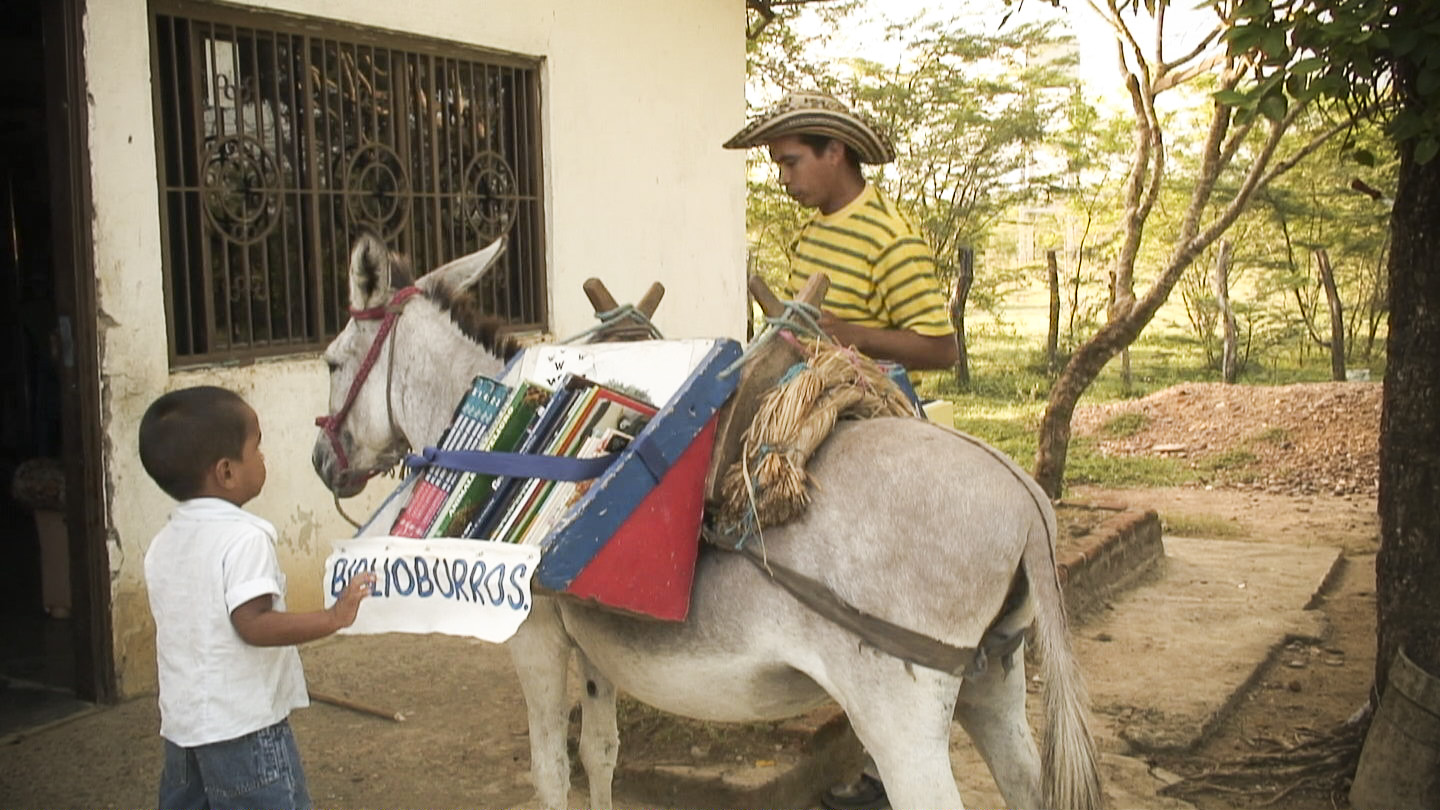
Have you watched videos or read about schoolteacher Luis Soriano’s biblioburro mobile library–books he mounts on his two donkeys & takes to children in remote regions of Magdalena Department (province) in Colombia? He named his donkeys Alfa & Beto, the two halves of the word alphabet in Spanish. (Fun bonus: the word literacy in Spanish is alfabetización. The biblioburros are definitely a literacy project!) See a delightful interview with him (with subtitles) at the link above.

Biblioburro

Photo from Wikipedia.

A two-year-old cousin of mine is currently entranced with the bilingual picture-book story of Soriano & his donkeys, Waiting for the Biblioburro by Monica Brown. I highly recommend it!

The work of literacy, of getting adults & children equipped & inspired to read, is work for social justice. Books open up our life possibilities, stimulate us to become better people & to respond to injustice, wake us up to the world’s beauty & pain. Sometime I’ll try making a list of books that have changed me. Today I just celebrate Luis & Alfa & Beto & all the children whose lives they are touching.


African faces of Colombia

Caras lindas front cover hr

Let me introduce you to a new book, just released in June: Caras lindas de Colombia / Beautiful Faces of Colombia. It collects stunning photos by Michael Bracey, a Chicago photographer of the African Diaspora, with English-Spanish bilingual text by me.

mike photo
Mike’s work has won a number of awards; he has published numerous other books, notably Africans Within the Americas, & is a foundation member of CAAAP (Chicago Alliance of African-American Photographers).

Mike & I originally met because I have been involved in Afro-Colombian advocacy, while Mike wanted to include Colombia among the places he has visited to photograph people from the Diaspora in the Americas & the Caribbean. (See samples of that work here.) For me it was an honor to plan a trip to Afro-Colombian communities with him & his wife María. We received significant help from Luz Marina Becerra Panesso, general secretary of AFRODES, the National Association of Displaced Afro-Colombians. “Luzma” is a fierce advocate for her people & a dear friend.

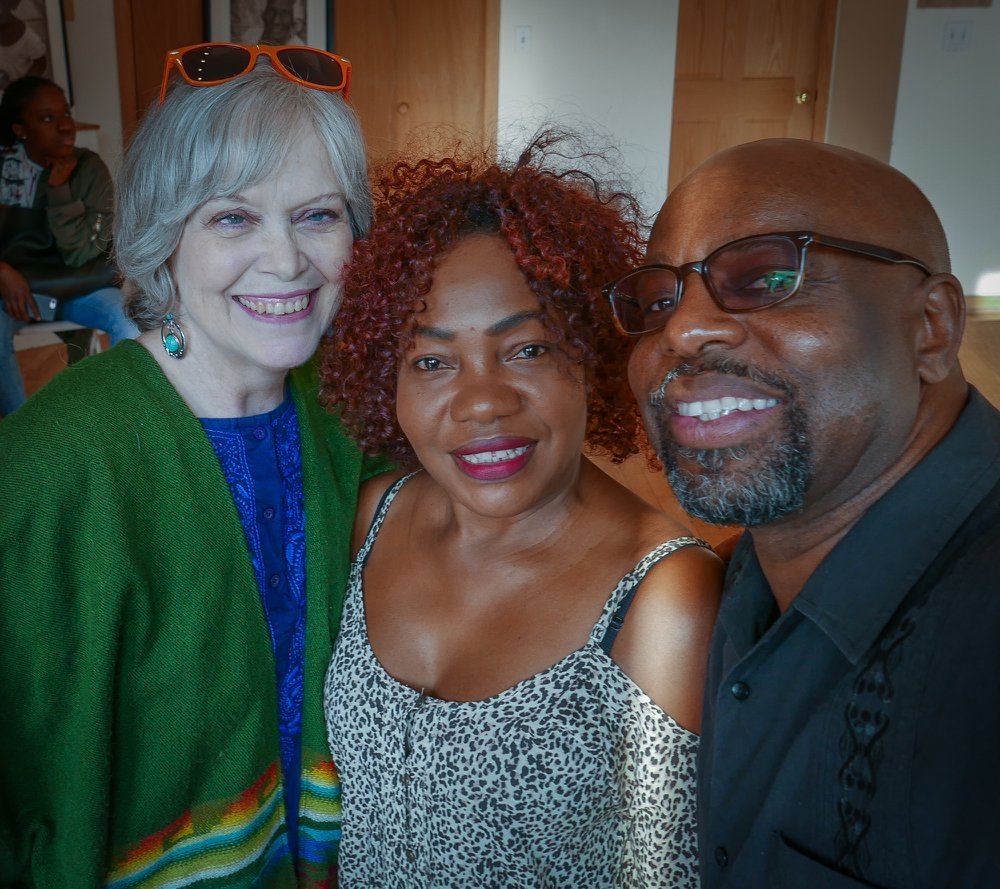
Ruth-LuzMarina-Michael
Here we celebrate the book’s launch with Luz Marina herself!

Our 2014 trip included many adventures & many tender moments, & Mike documented them all. Caras lindas de Colombia / Beautiful Faces of Colombia is one fruit of our journey, & we’re delighted to share it with you! Yes, of course it documents poverty & marginalization–but more than anything it’s a celebration of our creative, resourceful, & doggedly courageous black sisters & brothers in Colombia.

You can read a bit from the preface by Steve Bynum here (scroll down to the book’s cover) & then purchase the book directly from us here!

home & no home

My friend Jason Brown puts out an occasional gathering of writing & art, Home::Keep. The second installment, RE::DIS//MIS, was launched December 16. I am so grateful to be honored with a folio page for some of my Colombia poems & photos! Jason’s theme is home–our experience of it, our lack of it, our longing for it. Because about 7 million Colombians have been internally displaced by violence, the loss of home comes up again & again in my writing.

Folio :: Excavation // R Goring

054.JPG

Just one of the photos in the folio: my friend gazes at a galleon, replica of those on which her ancestors were forced to make the Middle Passage.

Prayer & hunger for justice

013_10A (1)

Being a friend is being a witness. In prayer we befriend God and each other, witnessing suffering, oppression, anger and perplexity, groaning, staying near, waiting for resurrection.

In early 2003 I had the privilege of praying with Afro-Colombian women and children in an isolated community that was under daily harassment by right-wing paramilitaries. The armed men had set up a base within a short walking distance from Puerto Lleras, an outpost of the Jiguamiandó community, which had committed itself to acting with nonviolence and to avoid cooperating with any armed groups. In February the paramilitaries had shot and killed an eleven-year-old boy, Hermín, simply for spotting them across the river and calling out to his father, who was fishing. A few days before I arrived in March, a man named Aníbal  had gone out to gather plantains and firewood for his family and had disappeared; his body was never returned to the community. The government had been unresponsive to pleas for help; in fact, it was known that the paramilitaries worked closely with the army battalion deployed in that region.

I had been invited to come to Puerto Lleras as an acompañante, an international witness. During my three days there, the “paras” entered three times. Each time they were spotted, the adults and children scurried to gather in the caseta, a roofed structure without walls that served as the community school. My role was simply to stand in front of them and ask the armed men to leave.

Our enemies were flesh-and-blood men carrying weapons and making threats. . . . “Whenever I am afraid I will trust in you.”

At the time of the second incursion, I had been reading my Spanish Bible. Once the paras walked off, some of the community adults went back to their homes, but others lingered. I asked them if they would like me to read some Scripture aloud; eagerly they said yes. A couple of the women suggested specific psalms. We prayed the words as we heard them:

O Lord, how many are my foes!
Many are rising against me;
many are saying to me,
There is no help for you in God.
But you, O Lord, are a shield around me,
my glory, and the one who lifts up my head. . . .

I am not afraid of ten thousands of people
who have set themselves against me all around.

There are many who say, “O that we might see some good!
Let the light of your face shine on us, O Lord!” . . .
I will both lie down and sleep in peace,
for you alone, O Lord, make me lie down in safety.

My reading of the Psalms was transformed that day. Until then I had generally spiritualized them—the enemies besieging me were my own failures, idolatry, lack of love, or great social forces such as consumerism and imperialism. Now, as in the experience of the biblical writers, the enemies were flesh-and-blood men carrying weapons and making threats.

Eventually our prayerful reading and singing was interrupted. Someone hissed, “They’re coming back!” The community members quickly, grimly, returned to the caseta.

A little girl with big eyes was wandering in the open area near me. I asked if her mother was in the caseta, and she shook her head. I picked her up.

And because there was nothing else to do I began to sing, first quietly and then louder, in English, a song based on Psalm 32:7:

You are my hiding place,
You always fill my heart with songs of deliverance.
Whenever I am afraid I will trust in you,
I will trust in you.
Let the weak say, “I am strong in the strength of the Lord.”
I will trust in you.

The armed men, seven of them this time, stared at me as they passed on the river path. They looked confused. The people behind me and the child in my arms fell utterly silent. The song took on force, rose into the trees, looped, and repeated several times, carrying us all.

Finally it stopped, and we waited. Having made their circuit through the settlement, the paras returned. They were young men, and the psalms we’d read had reminded me to love them. The leader made a stab at conversing with the community members, but after a woman burst out with an eloquent plea to be left in peace, the men walked off toward their base, obviously at a loss.

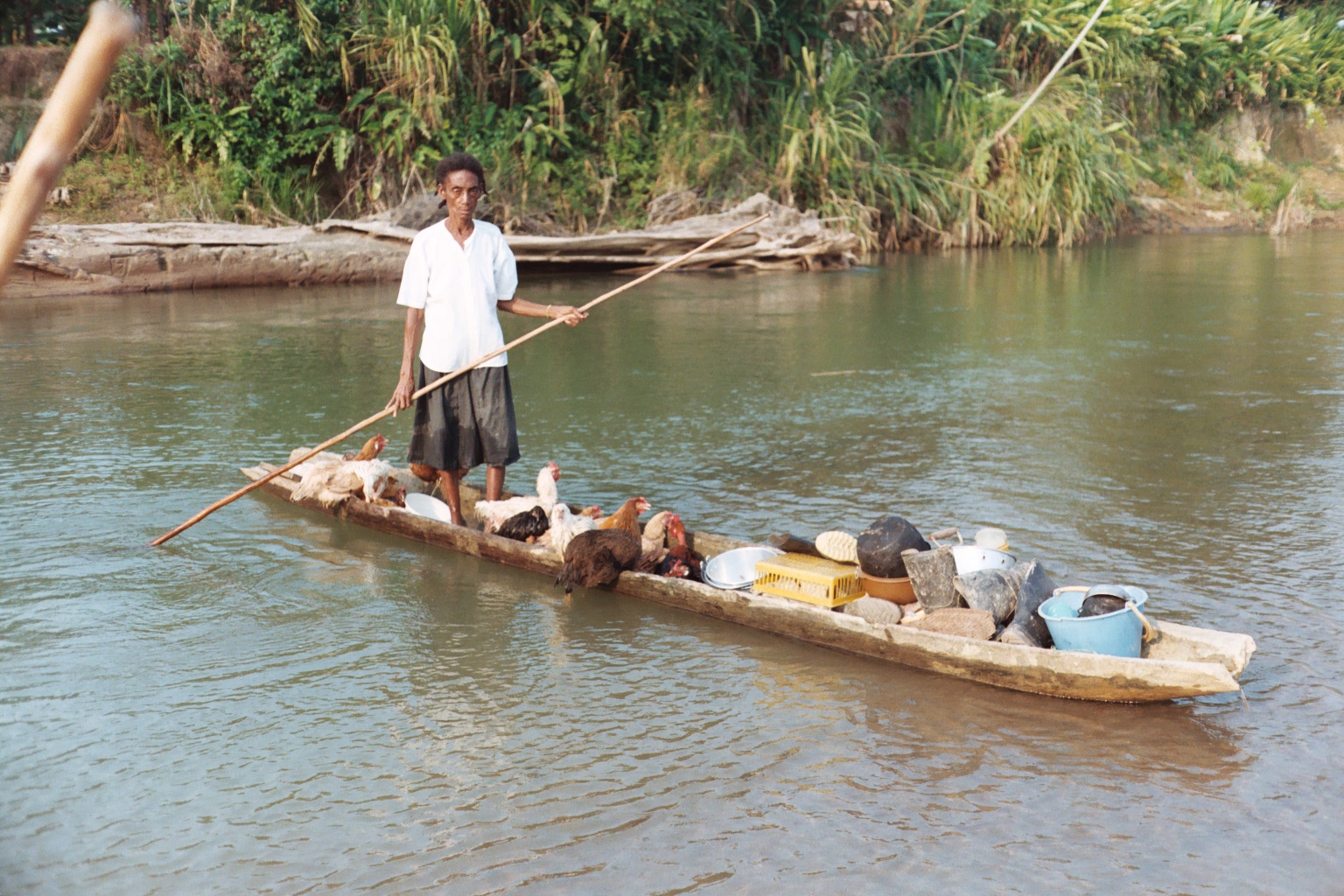
Within an hour, a few human rights workers arrived with large canoes poled by men from a sister settlement downriver. The people of Puerto Lleras hastily gathered essential belongings and loaded them into the boats—folded mattresses, pots and pans, bags of rice, clothes, potted herbs, chickens. The elderly and the little children found perches on top or in between, while the rest waded the shallow river and came together to pull the boats over sandbars.

The paramilitaries undoubtedly knew of our exodus, but they chose not to challenge us. After three and a half hours, we reached Pueblo Nuevo and unloaded. Our hosts promised to share food and living space until the people of Puerto Lleras had had time to set up their own dwellings.

Ever since that day, reading psalms has driven me to remember and to stay in prayer for the people of Jiguamiandó. Be a shield around us; lift up our heads; do not let our enemies have their way with us. You are our hiding place.