Not the way of the beast

In our time, the beast is money, racism, and domination.

The way of the beast is not the way of Jesus.

This coming Sunday I will be leading worship in our very multicultural church here in Chicago. And it happens that we are making our way through the book of Revelation, and chapter 13 is our surreal text this coming week.

I confess that it has been quite a while since I’ve read through the whole book of Revelation. But chapter 13’s account of the dragon and the beasts made sense to me immediately as I reread it today.

When you are thinking and praying every day about a genocide involving bombing, sniping, and starvation of children, women, and men with your country’s tax dollars,

and the many people around the world who care have not been able to stop it,

putrid beasts with ten horns, seven heads, and seemingly boundless power seem appropriate as representations of such massive evil.

One of the beast’s heads has been killed but the wound has healed over? I picture it flopping on its neck as the beast lumbers along, one of its dead eyes open and staring.

I wonder whether some of the heads have one horn and others two. Horns in scripture are symbolic of power and strength. The power here is utterly malevolent, and it has multiple manifestations.

We already know from earlier chapters that evil is conquered only by the Lamb who was slain—that is, by Jesus, through whom God entered our suffering and went all the way into death and hell for the world’s salvation. In chapter 13 the writer warns us that the evil of our day (the time of the original audience, but also our own) will sometimes be so vile and entrenched as to seem invincible. But Jesus’ victory-through-suffering still stands, and we must stay centered in that Love.

Because our congregation includes a whole range of literacy and education levels as well as multiple languages, after Revelation 13:1-8, 10b is read, a couple of the pastors and I are going to read out the following explanation in English, Nepali, and Kinyarwanda:

In every culture there are stories of dragons and other beasts: powerful forces that are hard to understand and to oppose.

Revelation 13 uses the language of beasts to picture the powers of this world.

This beast has seven heads and ten horns. It is scary!

The writer of Revelation is showing us the powerful evil in the world system.

In our time, the beast is money, racism, and domination.

The way of the beast is not the way of Jesus.

We are surrounded by the beast and its power, but we choose the way of Jesus.

We choose peace and justice, endurance and faithfulness.

When we pray for Gaza, Congo, Sudan, and other places where people are suffering, we are praying against the beast.

It is a long, hard battle, but Jesus triumphs through his life, death, and resurrection.

Let’s pray.

A prayer for the beaches of Gaza

by Ruth Goring

Before the ruin
when the sea was green breaking to white
and children chased each other
when the sun was life
and they picnicked: olives, hummus, bread

After the ruin
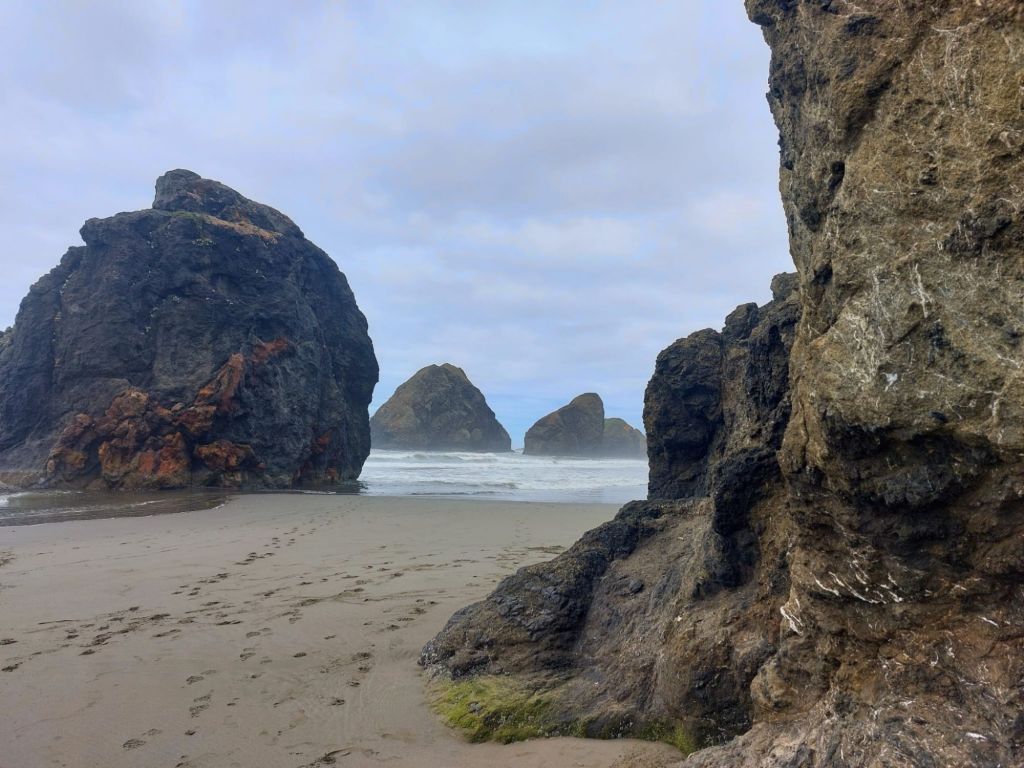
with my sister I walk among giants of rock
on the south coast of Oregon
Angels, old and black,
chant their subduction
the clash of volcanoes, islands
and small continents shoved up against
the continental plate

In Gaza the ruin has not ended
With no thought of beaches
hounded children crouch in tents
Their parents seek just a little flour
for bread

Dear angels of subduction
we set our hands on your vast shoulders
we ask for your strength
we pray against ruin

Before we rose, in the daylight of Gaza
bombs rained on the camps
and demolished demolished
one father, four children in a tent

One mother is left
and she has no feet

What is this world
What is this crashing
What raided the house of our belonging
left doors swinging on broken hinges
What suffocates us all
What ruin

Dear sentinels, dear Old Ones
we are not strong like you
we need our feet
we need gentleness and food
Dear God in heaven
come to the beaches of Gaza
and the tents, come now

Tell us
how we live in this bombing
or far away from it
with helpless hands

I walk out to one of the giants
lean against its ancient bulk
A wave rolls in over my feet
How do I live

Staying awake with Jesus

Good Friday worship can awaken a whole raft of emotions: love, gratitude, sorrow—and sometimes rage. In the final weeks of his life, Bonhoeffer wrote, “Christians stand by God in God’s hour of grieving.” What does that mean for us now?


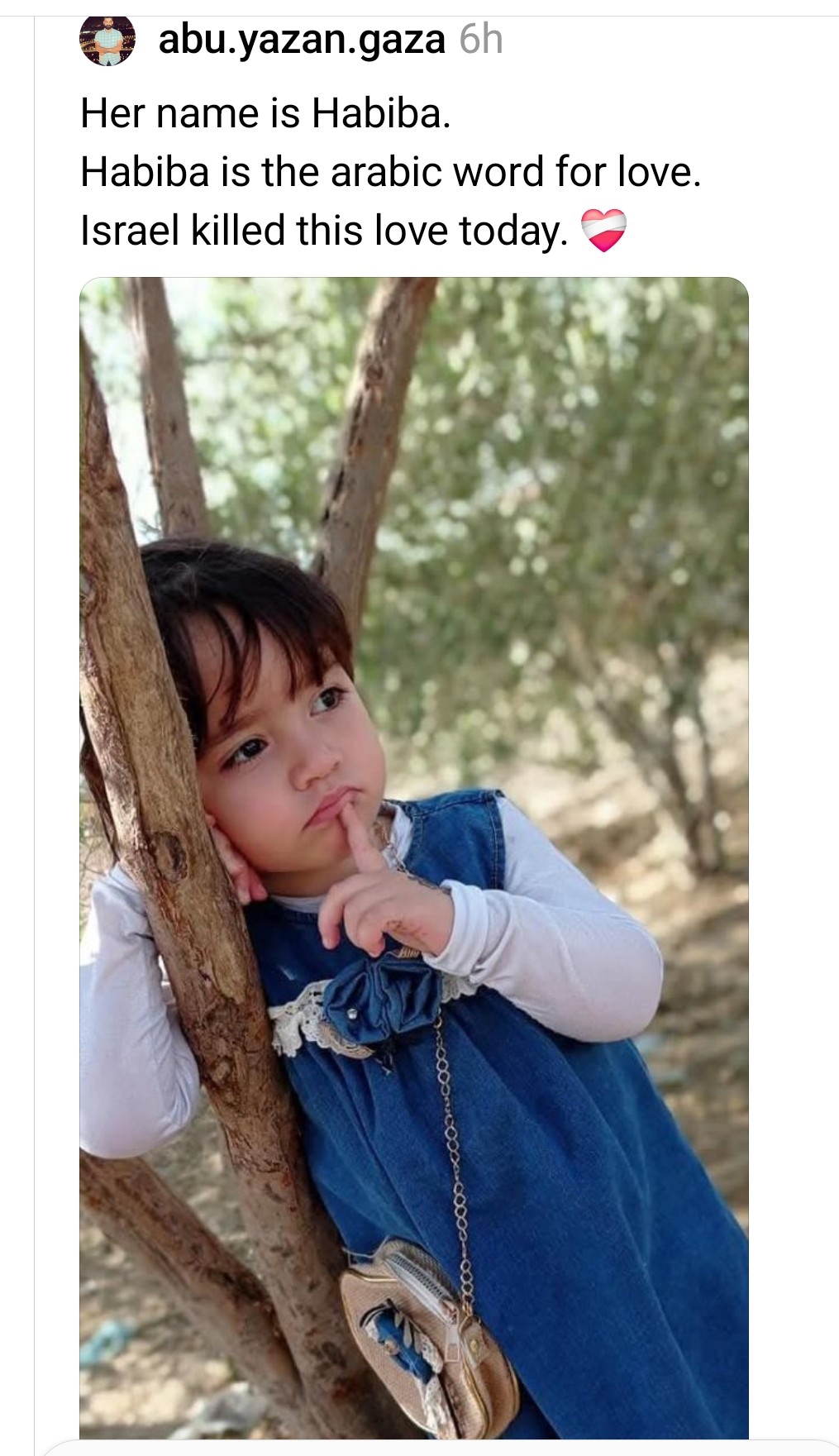
I walked home from church last night in a hot rage. Actually there was a mess of emotions—tender desire to stay awake with Jesus in his suffering; gratitude for the creative devotion of those who had crafted a series of sensory meditations to help us do that; distress over the loss of a beautiful Palestinian girl-child, which I had learned about on social media earlier that evening, and a beautiful Palestinian boy-child’s loss of limbs.

And fury at the broken promises of my country.

In eighth grade I was in the USA with my family, and in home room at Milburn Junior High School that year we were shown jerky films of skin-and-bones survivors of Nazi concentration camps. I will never forget those naked forms of human beings, beloved of God, starved to barely-aliveness. Barely able to walk, weighing barely enough for gravity to hold them to the earth. Those films came with solemn assurances that now we had the United Nations, we had an international system to make sure the Holocaust would never happen again.

Habiba and Mahmoud would beg to differ. The very country that claimed credit for stopping the Holocaust is now supplying the bombs raining down on the tents where their families are taking shelter. And that very country has been blocking the United Nations from putting an end to the genocide.

And it is my country. And many, many of us around the world are desperate to stop the violence, and thus far we have failed.

So I have no Easter platitudes to offer. I will go to church again on Sunday morning, and I’ll take joy in the resurrection story—I will cling to the hope it provides. But in my heart, until Israel’s crazed violence against the Palestinian people and land has been brought to an end, I will keep trying to stay awake with Jesus. Because Jesus is suffering with Mahmoud, and with Habiba’s bereft family, and with all of Palestine.

Habiba’s name means Love. She was killed on Good Friday.


Processing…
Success! You're on the list.

Let the wave wash over me

This evening as I walked toward Lake Michigan, I suddenly had the thought I’m almost exactly the same age Mom was when she died.

Then I thought, I have the life Mom would have wanted. Well, maybe she wouldn’t have wanted the public protest aspects. But among all my sisters and me, she would see the scope of possibilities she longed for, the freedom to take up space in the world.


As I approached the water, gray aqua and green against gray blue, a song I’d learned for our God’s Love Knows No Borders action came to me. It’s called just “The Wave,” and the songwriter, Miser, performs it as part of a longer song; but others have pulled out just one stanza and one repeated phrase, singing them in counterpoint.


It’s very odd to me, but as I age I become more aware of the ways misogyny has affected me throughout my life, and how I’ve been carrying an underground anger about it. This was where my thoughts turned next. The church in which we girls and women weren’t supposed to voice prayers aloud, even when we had an Easter hat or a Catholic doily pinned to our hair (we tried to obey certain scriptures very literally). The work as a bilingual secretary for $1.75 an hour, from which I was driven home to change clothes the day I wore a perfectly modest dress whose split skirt showed in the back. The husband who said the Bible gave him the right to demand sex on his schedule. The boss who didn’t want to promote me because I was so good at detail work—“you are irreplaceable.”

The resentment was mostly buried for decades. In the contemplation that retirement allows me—you will laugh, please do laugh—it has come into my awareness partly through online mahjong games that I often play. Certain pieces/symbols are masculine in my mind, and I find myself trying to rid the digital board of them as quickly as possible.

I try to keep the flowers and the birds, and to end each game with them. It’s surprising how often I succeed at that.


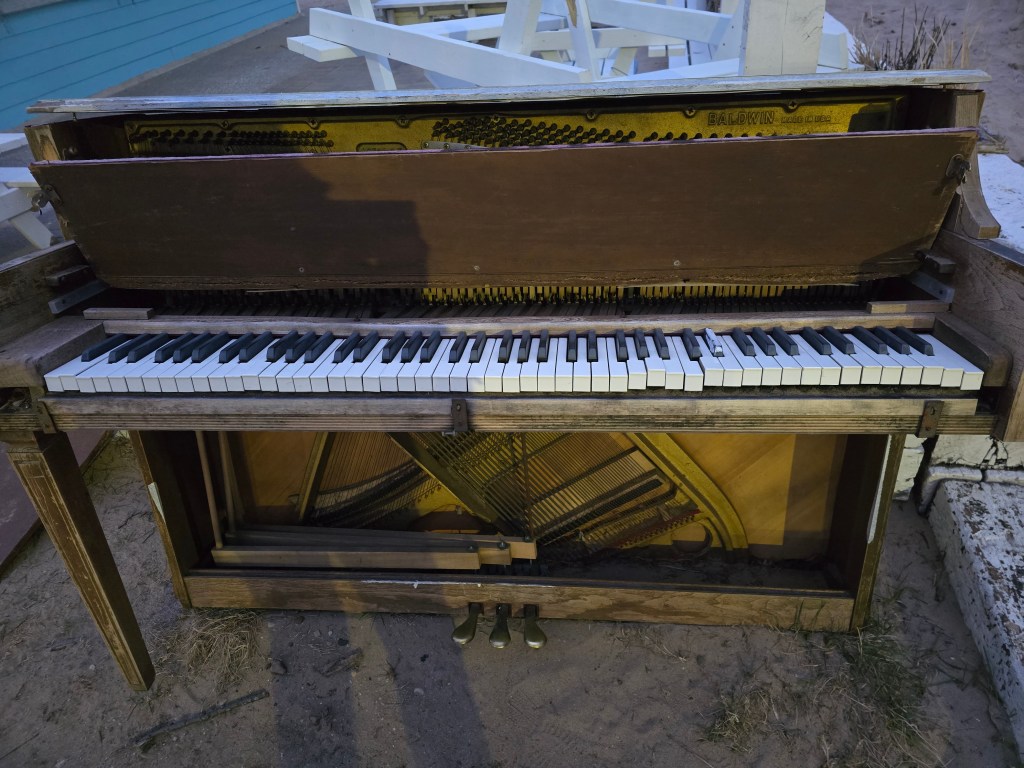
I started singing “The Wave” softly as I walked. And on the way home, there was no one at the beach piano. I found an octave in which most of the keys were not yet stuck, and played it.

So simple, and still one note couldn’t sound, but it was carrying me. Though I’m not sure what the songwriter originally intended, the song is saying to me that the pain and struggle of this time sometimes washes over me like a long wave. But “there will be better days”: waves can also buoy us. We rise and sink, and rise again.

I have happy, warm relationships with my brothers, my son, many male church friends, writers, artists, activists. When I encounter misogyny, I can back away and leave it to God. When it’s expressed against another woman, I can speak up to support her.

Despite the limitations my mother experienced, she had a beautiful, meaningful life, and she never stopped growing. When her time came, she let the wave of death wash over her with peaceful abandon: she knew she was headed toward greater Life. I pray to be like her.

Dearworthy

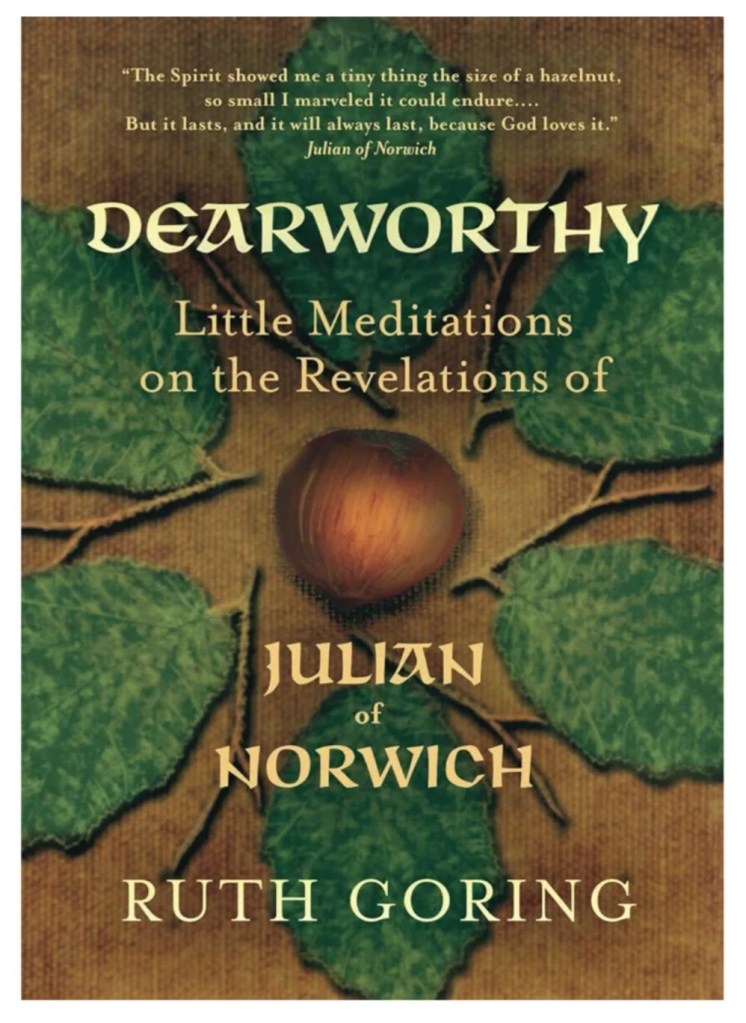
My book has launched! Anyone who has caught sight of me here or on other social media in the past couple of years knows that for a while I’ve been writing and thinking about the medieval Christian mystic Julian of Norwich and creating botanical art to accompany key excerpts from her writings. Now these meditations are available in a lovely little collection published by Anamchara Books.

The work has been a beautiful journey for me: it involved not only learning a lot about Julian but also learning digital art techniques—some via online classes, some by trial and error. All writing is discovery, and this writing led me into my pain and failures but also into breathtaking experiences of the immense and tender love of God.

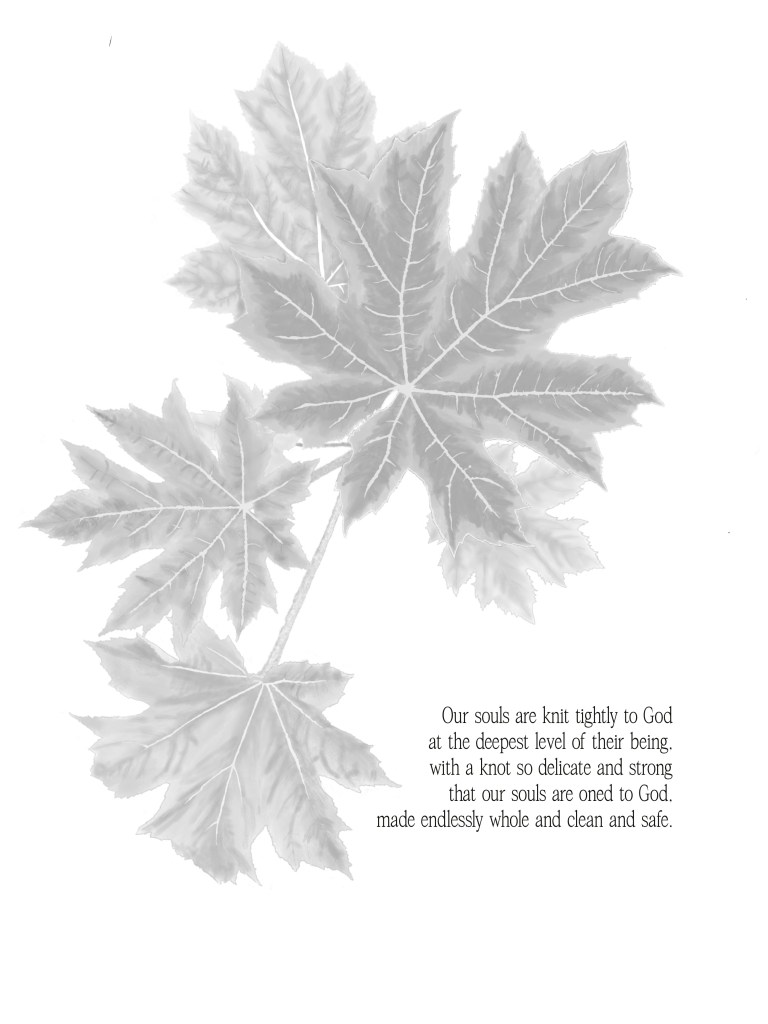
What does it mean to be “oned” to God? For me it has meant centeredness in God’s steady presence, release from nagging anxieties—and also new freedom to act in public solidarity with God’s beloveds who are suffering. The song that God sings over us is a song of suffering-with, of being-with. It is for sharing, for as Julian says (in Ellyn Sanna’s paraphrase), “The happy comfort revealed to me is big enough for us all.”

Dearworthy: Little Meditations on the Revelations of Julian of Norwich is an invitation into profound comfort and belonging and meaning. I hope you will read it and share it with others. I pray that it will be a good companion in your own journey into Love.

Moral injury

An open letter to US elected officials

On the sad anniversary of Israel’s intensified attacks on Gaza, recognized around the world as a genocidal campaign but supported unconditionally by my own government, I have written a letter that I will be posting in the following online forms. If you feel moral injury as I do, you are welcome to copy and adapt this letter to share with your own electeds. Here are sites for my representatives, along with links you can use to communicate with yours:

President Biden: https://www.whitehouse.gov/contact/share/

Vice President Harris: https://www.whitehouse.gov/contact/vicepresident/

Senator Richard Durbin: https://www.durbin.senate.gov/contact/email

Senator Tammy Duckworth: https://www.duckworth.senate.gov/connect/email-tammy

Representative Jan Schakowsky: https://schakowsky.house.gov/zip_authentication?form=/contact/email-me

Find your senators: https://www.senate.gov/senators/senators-contact.htm

Find your congressperson: https://www.house.gov/representatives/find-your-representative

Dear President Biden, Vice President Harris, Senator Durbin, Senator Duckworth, Representative Schakowsky:

The Earth has made a complete orbit around the Sun since October 2023, and thanks to all of you, the world has been witnessing the first genocide of the twenty-first century during these twelve months.

  • You did not acknowledge that Hamas’s incursion into Israel on October 7, 2023, was inevitable given the cruel and unrelenting blockade of movement and resources that Israel had maintained over Gaza for many years.
  • As Israel began carrying out its revenge and targeting the civilians of Gaza, you seized the opportunity to assist it with countless lethal weapons, including 2,000lb bombs, which it has used to incinerate refugee camps, killing whole families, and has dropped on other homes and on schools, universities, churches, mosques, markets, and farms. It has targeted water plants and left people drinking fetid water from puddles and ditches. It has committed one war crime after another. Its snipers have gleefully targeted older women like me, its snipers have shot children in the head. Its soldiers film themselves laughing while they humiliate prisoners. These videos have been posted on social media for the whole world to see.
  • You have wrinkled your faces in expressions of empathy and urged Israel to minimize civilian casualties and investigate a couple of the many reported incidents of human rights abuses. You know full well that Israel will not investigate its misdeeds honestly.
  • While supposedly waging this assault in the name of freeing the hostages held by Hamas, Israel has killed a number of those hostages, again with US weapons.
  • About a dozen employees of UNRWA were accused of participating in the October 7 raid or supporting it some way. UNRWA promptly fired those employees. But instead of lauding its quick response, you cut off support for UNRWA, the only source of food for thousands of Gazans, and you influenced other Western governments to do likewise. With trucks carrying aid blocked by Israeli soldiers and settlers at all the crossings, the people of Gaza who have not been killed are starving. They walk the streets like ghosts.
  • Rep. Schakowsky, months ago you justified voting for a bill that included another huge sale of weapons to Israel with a long statement arguing that it was the only way to get desperately needed food aid to Gaza. Do you not understand that dropping boxes of food is stupendously offensive when you have also provided Gaza’s enemy with massive weapons and artillery to kill those hungry people?
  • President Biden and Vice President Harris, you claim to be working “tirelessly” for a ceasefire. Surely you are aware that Hamas is not the one putting up obstacles to a ceasefire agreement. It has agreed multiple times to US-backed proposals. Netanyahu’s government is the intransigent party every time. Indeed Israel sent assassins to kill Hamas’s chief negotiator, Ismail Haniyeh, in Tehran. Netanyahu knows that his administration will fall apart if he says yes to a cessation of hostilities. And he has absolutely no positive reason to say yes, given that the United States continues to blithely send weapons at the rate of two shipments every single day.
  • You are violating multiple US laws each time you send those weapons to Israel. We are under obligation to stop arming any country that commits human rights abuses in its conduct of war. But somehow you see yourselves as above this law.
  • Emboldened by your encouraging words (“we will never abandon Israel”), Israel has increased its violence in the West Bank. And now Lebanon, Yemen, Iran, Syria . . .

I am deeply ashamed of you as representatives of the country where I vote and pay taxes. You seem blissfully unaware that as you enable the destruction of Gaza and its people, you are also inflicting profound moral injury on the people whom you were elected to serve and represent. Moral injury happens when great evil is done in our name and we are powerless to stop it. The people of the United States do not approve of your support of Israel’s carnage, and we have been letting you know in polls, petitions, phone messages, street protests. But you do not listen to us. In this election season you are probably glad to be running against Trump and all the Project 2025 people, because their plans are so horrific that when we shut our eyes to Gaza, you seem like the good guys. But we know. Even ardent Democrats know that you are injuring us as you wrap yourselves in the Israeli flag. You are injuring the whole world.

Do you remember Aaron Bushnell, the Air Force serviceman who immolated himself in front of the Israeli embassy last February, crying out “Free Palestine”? Did you dismiss his agony because he wasn’t your constituent? Aaron saw your complicity in genocide—a complicity that we all share as taxpayers. You are using our money and you are killing our souls as you arm Israel so that it can starve, torture, and kill the people of Palestine.

I am seventy years old, a mother and grandmother, an artist and writer, a follower of Jesus. I live very modestly but have a rich and beautiful life. And on this anniversary I am contemplating Aaron Bushnell’s action. I am wounded by what you are doing in my name, and I’m wondering what desperate public step I could take to wake you up.

You probably wouldn’t care much because I don’t donate to your campaigns. And since you can see the images of Gazan babies killed by US bombs and you keep sending the bombs anyway, you wouldn’t be moved by any sacrifice I might make. You have political reasons that completely override public or personal ethics.

It is exhausting and heartbreaking to live in the world that you are destroying. But I believe that somewhere in your core, you, like me and like every human being, still have a soul that longs for God and reaches for the good. Will you begin to shut out the political pressures and listen to your own soul? Are you able to reverse course—to repent, to use an apt biblical term? You don’t have to stop being a politician: you could actually start listening to your constituents and help to assuage our moral injury. You could uphold US law and impose an arms embargo. You could save dollars that way and direct them toward reparations for the people of Gaza and meeting urgent needs for healthcare, education, and housing here in the USA.

You could. Will you?

In grief and necessary hope,

Ruth Goring

Chicago police gathered around me in June 2024 as I lay shrouded on Franklin Street in front of the building where AIPAC has its local office. Along with ten others, I chose arrest and jail in order to make vivid the deadly consequences for Gaza of our country’s unethical Middle East policies.

Photo by Michael Bracey.

All manner of thing shall be well

For a good while now in my newsletter and on my Instagram page, I have been exploring Julian of Norwich’s wisdom via botanical images and short meditations. Because the phrase for which she is principally known—“all shall be well”—can easily become sentimental, I’ve been slow to write about it. But I have thought about it, a lot, and the time has come to take it up. And to write about this in a longer form seems important.

            First, the word well. Julian uses it frequently to express her desire for the world, so I looked up the etymology—she wrote six and a half centuries ago, after all! Well in her day was understood to mean abundant, as desired, satisfying, lacking nothing. Julian was essentially seeking the Hebrew state of shalom: peace, well-being, healthy relationships, love.

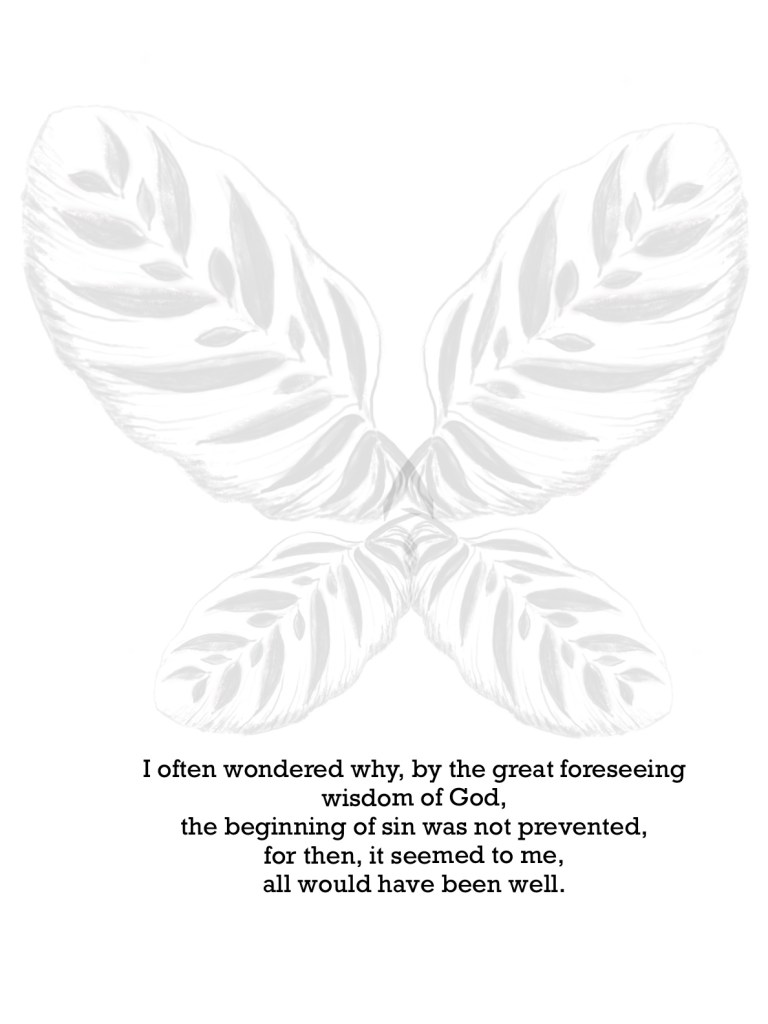
            Julian asks God about wellness for the world more than once. How can things become well, when evil seems to permeate the world so thoroughly? Wouldn’t all have been well if sin had been prevented in the first place? Couldn’t God have thrown up an impenetrable barrier against it?

To accompany Julian’s question, I drew a single leaf from the peacock plant. Peacock leaves display a striking green and white pattern, as if painted. In my drawing I repeat the leaf in a symmetrical arrangement to symbolize what my own mind wishes for: perfection as symmetry, clean and free of blemishes or suffering. Julian longed for such innocence and worried hard over God’s reasons for allowing sin. “I ought much to have given up this disturbing wondering,” she admits ruefully, “but nevertheless, I made mourning and sorrow about it without reason or discretion.”

            I’m glad the questions troubled her. They trouble me too. I will never forget one night in my young adulthood when, having learned of a Colombian baby born with a genetic abnormality that caused chronic pain, I tossed, turned, and wept in bed. The child was receiving tender care at my parents’ foster home, but still, how could a good God have allowed this? How could God ever make it up to little Diana?

            You may well have endured a night like that. Or a day, or a week, or many months. You may be Diana, suffering incurable chronic pain.

            How can all be well?

*          *          *

I was tempted to leave the question hanging and try to do justice to “all shall be well” in a later post. But I won’t. Here’s how I understand God’s response to Julian’s anguished cry.

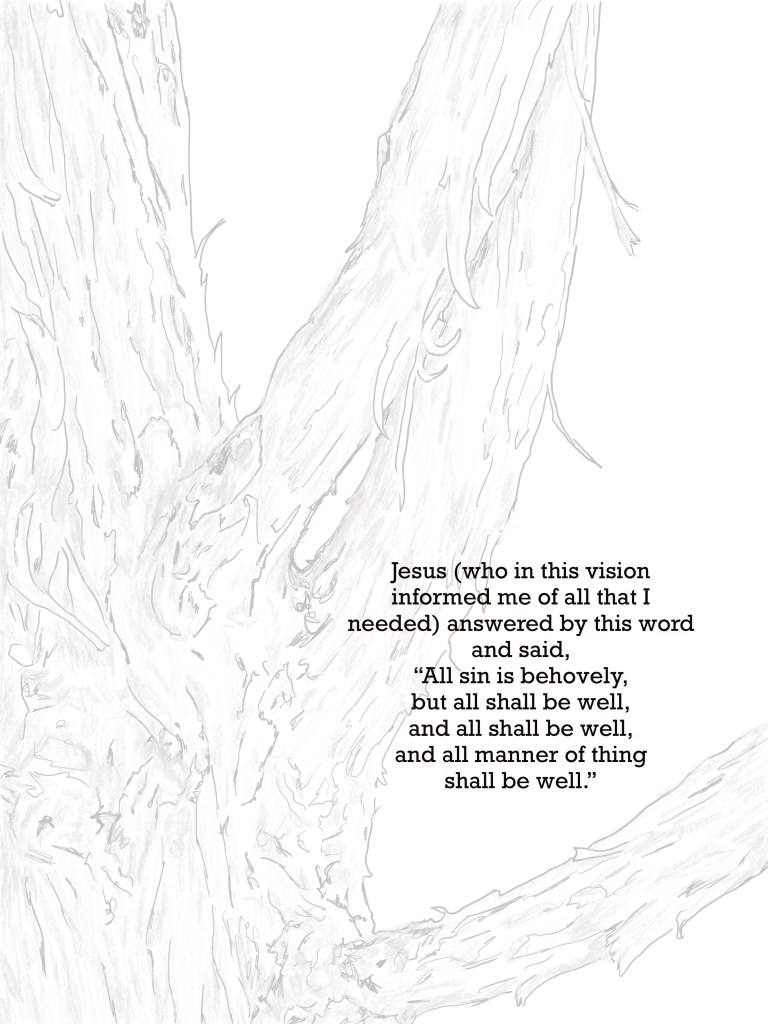
I chose to draw part of a bald cypress tree in late autumn to accompany the words Julian heard Jesus say. I think you’ll see why.


            Jesus tells Julian that sin is “behovely.” I retained this Middle English word because there’s some discussion among translators about its meaning. The phrase “it behooves us to ____” incorporates a more recent version of the term: we need to do x, it is the right thing to do. Behovely could mean necessary. It could mean appropriate. The late Father John-Julian, whose Julian translation I’ve been adapting, chose inevitable here.

            Jesus doesn’t answer the how-question directly, but he seems to be saying that sin (which has no being in itself but is parasitic on God’s good creation) is an occasion of something beautiful. Because of Adam and Eve’s fall, the Second Person of the Trinity fell into the creation and identified with its suffering, becoming the Child of Humanity. The story of God’s involvement with the world is still being told. It is a story of redemption, of movement toward shalom.

            The Lord doesn’t say shalom, of course. Jesus uses Julian’s own word, well. I find it sweet that Mother God offers Julian this mirroring, the way a human mother repeats her toddler’s words to affirm them and maybe help the child to pronounce them clearly.

            Julian has rebuked herself for her desperate struggle, but Mother God does not scold her. Quite the opposite.

            Your desire is good, Mother God is saying. It is my very purpose. The promise is never conditional: indeed all shall be well—abundant, lacking nothing, satisfying.

*          *          *

Julian’s earlier showings include strange and gruesome visions of Jesus’s sufferings on the cross. I am not drawn to those images, but Julian found them marvelous and comforting. I think she was able to believe God’s assurances of wellness—well-being and restoration of all that is damaged—because she had seen Jesus suffering with us.

            The healing of all things does not involve a magic wand. It’s not the detached action of a god who is playing a cosmic game. Jesus suffered damage just as we do. The need for things to be well is personal for Julian’s Lord.

            The “when” that goes unvoiced in Julian’s question is implicitly eschatological, and another day I will write about her blazing insight into the Last Things. For now, let’s simply burrow into the promise.

           All shall be well, and all shall be well. And all manner of thing shall be well.

           Oh child, Mother God says. Your desire is not too much for me. You don’t even know how much and how many things need to be set right, to be brought into wellness. It is more than you can ask or imagine. I promise you, though, that restoration is for all. Not just for humans, not even just for creatures that breathe. Every kind of every thing shall be well.


If you want to explore Julian’s theology further, I highly recommend Amy Frykholm’s May 2023 article “Julian the Theologian.” And there are more writings and podcasts to check out on my Julian’s Porch page (see menu).

Sign up for my newsletter!

Processing…
Success! You're on the list.

Help is on the way

I have always loved Psalm 121 (text below). It’s one of the Psalms of Ascent, which pilgrims to Jerusalem would sing as they walked toward the celebration of one of the three annual feasts. The opening phrase—“I lift up my eyes to the hills”—is so simple and evocative. It reminds us of those moments of quiet awe when we’re out in creation and can rest our eyes on distant hills or mountains.

I lift up my eyes to the hills—
    from where will my help come?
My help comes from the Lord,
    who made heaven and earth.

[Our Creator] will not let your foot be moved;
    the One who keeps you will not slumber.
The One who keeps Israel
    will neither slumber nor sleep.

The Lord is your keeper;
    the Lord is your shade at your right hand.
The sun shall not strike you by day
    nor the moon by night.

The Lord will keep you from all evil;
    the Lord will keep your life.
The Lord will keep
    your going out and your coming in
    from this time on and forevermore.

Psalm 121 (NRSVUE)

            However, recently I’ve gotten a different vibe from this psalm. Creating an illustration to be included in The Peace Table Bible storybook brought this to the fore. Of course before beginning my image, I read the psalm again and meditated on its narrative. Why is the psalmist (or singer) lifting their eyes? It doesn’t seem to be for refreshment or awe. The speaker/singer needs help. And it’s not that a rescuing army is about to sweep over the crest of the hills! It’s God who will be the source of help.

            “The Lord is your shade at your right hand,” promises the psalmist, so that “the sun shall not strike you by day, nor the moon by night.” This song is about a trek through a desert landscape where sunlight can be harsh and unrelenting, where night brings other dangers.

            So I decided not to sentimentalize Psalm 121 in my illustration. I chose metal vintage-watch pieces for the sun, moon, and stars. On the left the figure—singer of this psalm—is panting with the effort of climbing under the sun’s glare. On the right the pilgrim has made it over the hill but must sleep in the open air in darkness, vulnerable to human raiders or wild animals. God’s help is needed for every step along the way.

Photo by Michael Bracey


More recently I’ve been crafting a picture book that tackles climate change and plastic pollution, and seeks to enchant readers with a vision of the beautiful communities of humans and other animals, plants and air and mountains, that can emerge when we take up the work of restoration and healing. This is a pilgrimage we’re invited into today: the journey of changing our lives to lessen climate change and keep Earth inhabitable. Let’s find songs that remind us of God’s loving attentiveness and help all along the way. Let’s find rhythms of joy and mutual care.


As always, you’re also invited to sign up for my newsletter, which will bring more art and meditations to your inbox!

Processing…
Success! You're on the list.

Jesus Our Mother

My sermon preached December 11, 2022, at Living Water Community Church, Chicago

Isaiah 49:15-16 [NIV Readers ed.]

The Lord answers, “Can a mother forget the baby
    who is nursing at her breast?
Can she stop having tender love
    for the child who was born to her?
She might forget her child.
    But I will not forget you.
I have written your name on the palms of my hands.
    Your walls are never out of my sight.”

Luke 13:34

Jesus said, “Jerusalem! Jerusalem! You kill the prophets and throw stones in order to kill those who are sent to you. Many times I have wanted to gather your people together. I have wanted to be like a hen who gathers her chicks under her wings. And you would not let me.”

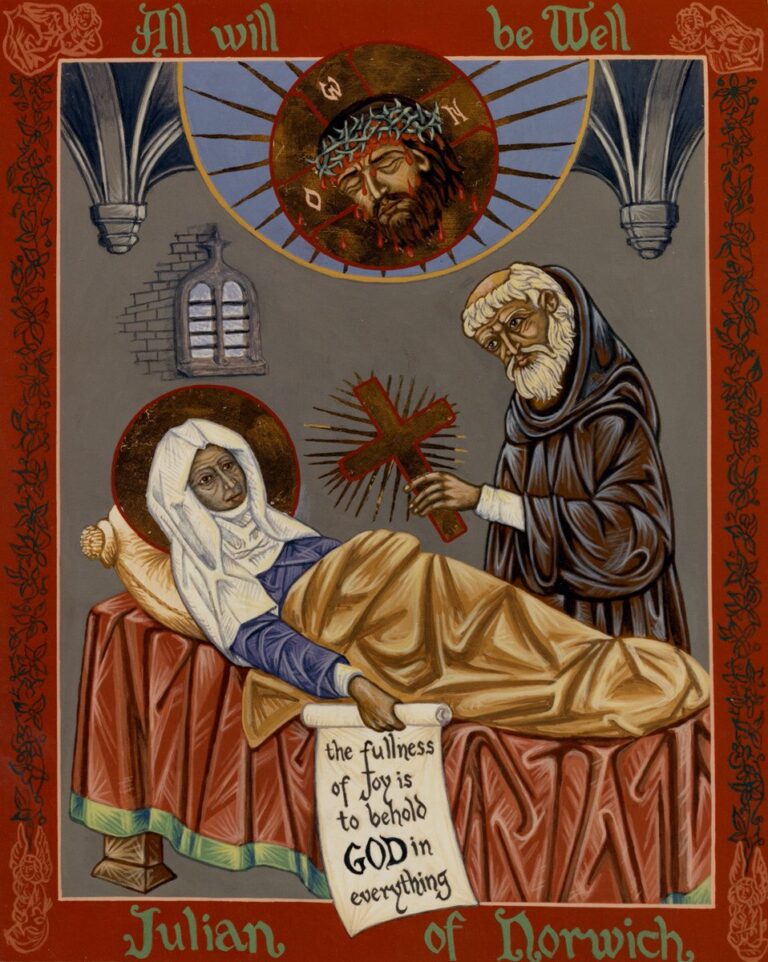
For a number of years now Julian of Norwich has been a good friend and sister to me, starting well before the pandemic began and deepening in these years of solitude. I am delighted to speak to you today about some of her insights into who God is and how Jesus sees us and loves us.

Julian’s writing is not on the level of Christian scripture. It has not been considered and studied for twenty centuries. It seems to have been little known even within the English-speaking world for a good part of the nearly 650 years since Julian received her revelations, though she is recognized as the first woman to have written a book in English. But Julian is being studied more intensively as of late, and she is recognized as a complex thinker and a mystical theologian who has much to offer.

A few basics about her. She was born in 1342 and lived till at least 1416. We are not sure about her name. All the other Julians we know, in history and in our congregation, are male. 😊 Some believe Julian was adopted as her religious name from St. Julian’s Church in her hometown of Norwich, England. But it’s also said that Julian in medieval times could be a name for either a woman or a man.

As a devout young woman, Julian prayed some prayers that are strange to us but not so strange for a dedicated believer of her time. She prayed (1) to come close to death, (2) to see Jesus’s suffering on the cross as if she were present, and (3) to be marked with three “wounds”: contrition, compassion, and deep longing for God.

At age 30 Julian became deathly ill, perhaps from the Black Death—bubonic plague which was sweeping through England repeatedly in those years. She very likely had already lost her husband and at least one child to the plague. All of those prayers were answered as she lay on her deathbed, having received last rites. As she gazed at a crucifix, Jesus’s suffering became very vivid to her and she received a series of “showings” or revelations—visions of Christ’s passion and messages from God. These showings, and her conversations with God about them, determined the remainder of her life.

Julian went into enclosure at some point after receiving her revelations. Enclosure here means moving into a very small space permanently in order to pray and serve God. She became an anchorite, which is different from a nun or a hermit. Nuns generally live in community. Hermits live in almost complete isolation. An anchorite lives in a small cell attached to a church. Julian’s cell was attached to St. Julian’s Church.

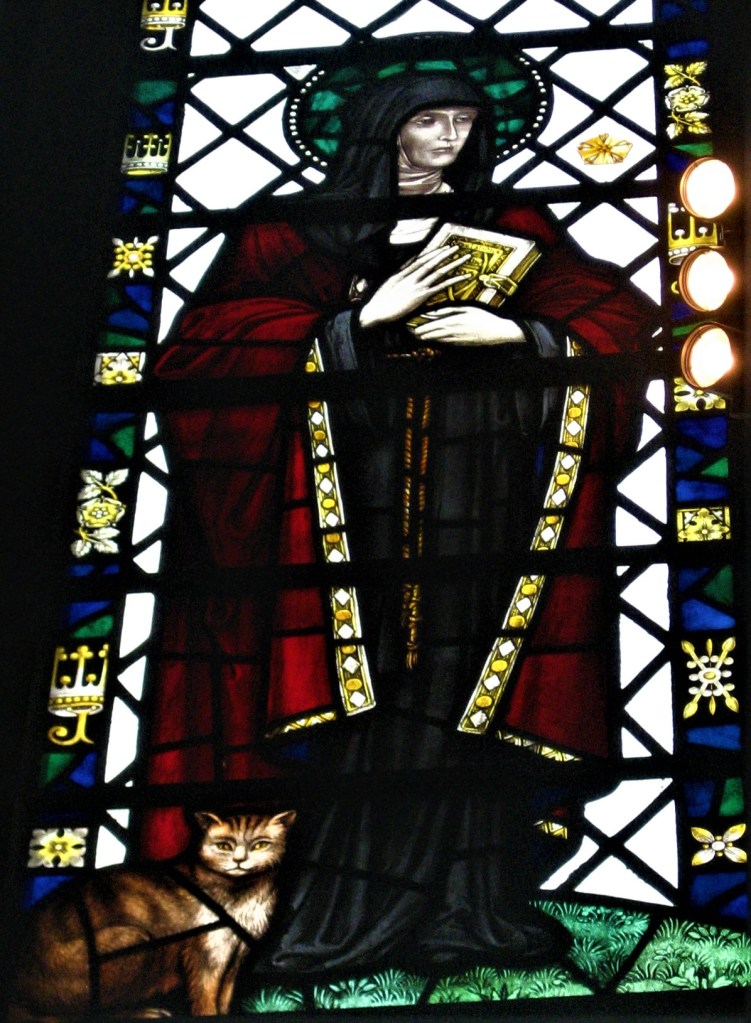
Her cell had another tiny cell attached, where another woman lived and did the necessary practical tasks like cleaning and buying food. Julian devoted herself to prayer and writing, except that in the afternoons people from the community could step onto her cell’s little porch and speak to her through a curtained window. She was essentially a spiritual director to them. And she is often portrayed with a cat, as in the above stained-glass window in Norwich Cathedral today.

The Roman Catholic Church was the only official church in England at this time. The church and the government were tied very closely together. The Mass was in Latin, which was not the language people spoke. And the Bible was read only in Latin. John Wyclif also lived in England at this time, and he took a big risk to translate the Bible into English, which was against the church’s laws. If you were one of Wyclif’s followers and were found to have an English Bible in your house, you would probably be taken outside the city and executed.

Julian probably didn’t know how to read and understand Latin; she calls herself uneducated. So she couldn’t study or quote the Bible the way we do. But she would have learned a lot through sermons and through church processions and plays in English, in which people acted out stories from the Bible. Stained-glass windows were visual ways for people to become familiar with characters and events from the Bible.

Julian did know how to read and write in English. And somehow, even though some of her writings challenged official church teachings, they survived in two handwritten copies and have been translated into modern English.

So here we go with some of Julian’s writings.

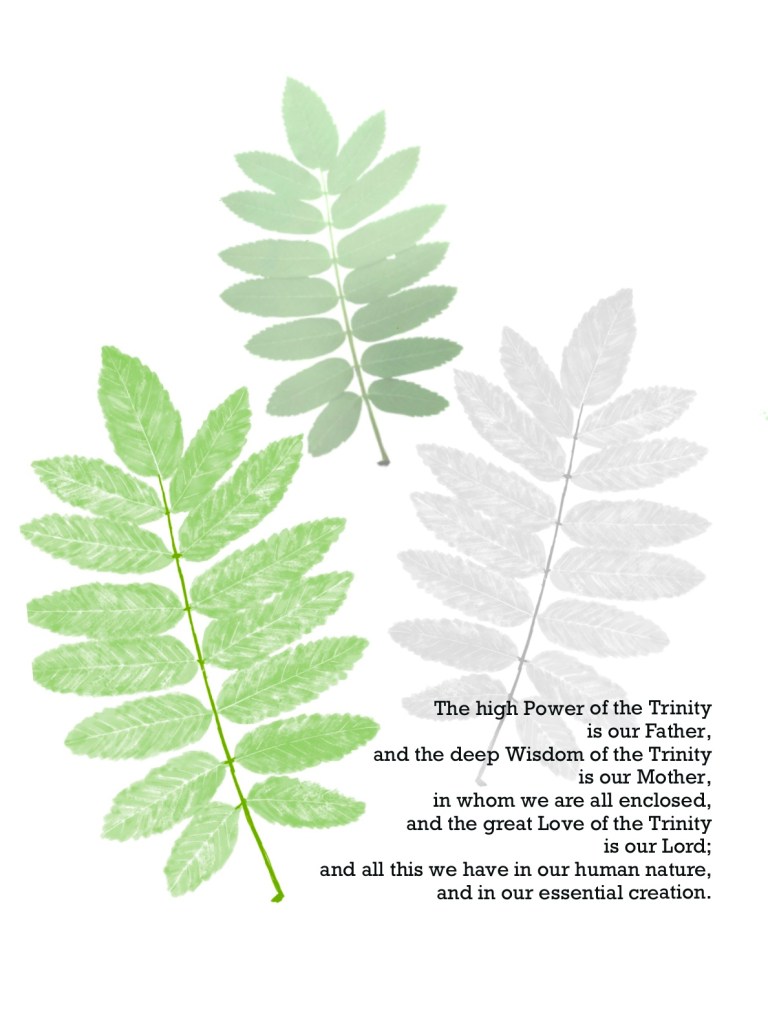
I have been combining botanical paintings with some of my favorite quotations from Julian. Julian pays a lot of attention to God as Trinity as she explores the riches of God’s self-revelation. Notice her titles here for the members of the Trinity:

  • Power for the Father—not surprising
  • More surprising: Wisdom for the Son, whom she calls Mother—we’ll talk more about this
  • Also surprising: Love for the Spirit. Julian also calls the Spirit Goodness. I had been used to thinking of the Holy Spirit almost as a mere conduit or a communicator of God’s power and wisdom. Thinking of the Spirit as Love and Goodness in herself is fresh for me, and it strikes me as good theology.

Today we’re going to focus on the Second Person of the Trinity in Julian’s writing, so I have put together some images and quotes about Jesus. Julian is especially surprising when she writes about Jesus as our Mother. I love thinking about this in the context of Mary becoming pregnant with Jesus.

First, not only do we share the richness of the Trinity in our essential creation, as the previous slide said. But also Jesus wishes and chooses to enter our humanity. Jesus is the source of our human nature (which Julian calls “fair”—that is, positive and admirable). And here Jesus is our Mother and our Home: we are born from Christ, we are enclosed in Christ, our life is a journey into Christ.

Jesus establishes our identity in himself and considers it very good.

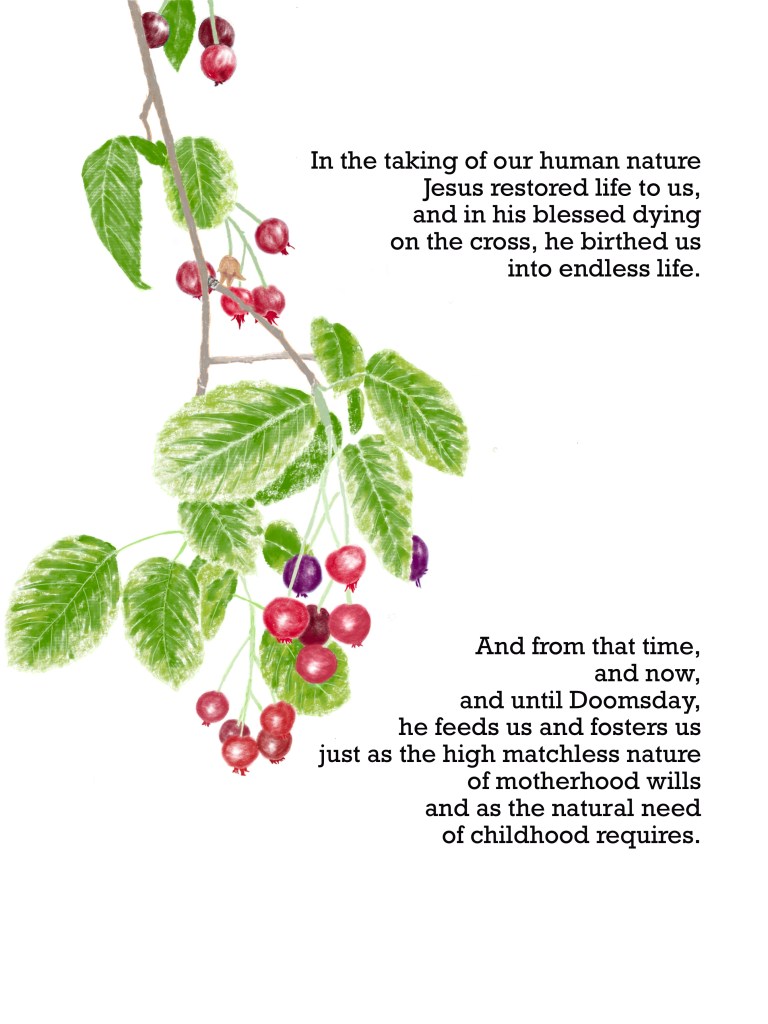
Regardless of our precise theology of the cross, I think believers generally understand that Jesus suffered there for us and with us. So Jesus is our Mother not only as our source but also as One who suffers to give birth to us. Indeed what Jesus endured on the cross is for the life of the whole world. Our deliverance from sin and evil can also be understood as a delivery—Jesus giving birth to us.

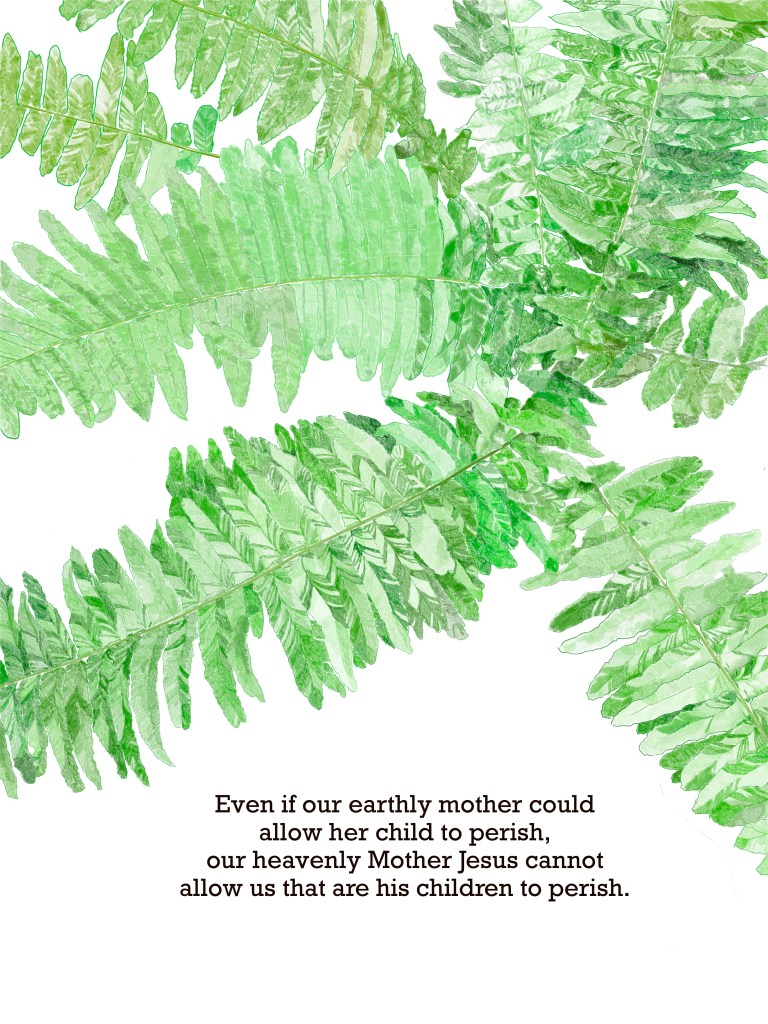
If we were all able to live according to our good human nature and identity, we who are mothers would never neglect or forget our children. But we fail at times, as Julian recognizes here, echoing the words of the writer of Isaiah. Jesus as our Mother, however, will never forget or neglect us.

My own mother was a wonderful person, but she was rather hard on me, lashing out occasionally with physical violence or withering words. I think I reminded her of the failings of my dad that made their marriage difficult at times. Knowing God as my Mother has been deeply healing for me—especially opening up to God’s loving gaze, a bonding gaze that is never averted from me. It’s hard to express how bountiful life has become for me as I’ve meditated on Julian’s confident insights into Jesus’s motherly love.

This is a beautiful summary statement of what the incarnation and the cross mean as Jesus’s mothering of us. And look at the threefold promise of Julian’s next sentence: in the past, the present, and the future Jesus continues to feed and foster us. Jesus gives us the food we need to survive both physically and spiritually. And Jesus fosters us like a mentor, helping us to become more and more fully ourselves.

So our life is grounded in the life of our Mother. I want to encourage us to use the title Mother for Jesus, or for the triune God, more often and more freely. We are most used to saying Father (Baba) or Lord (Bwana), but the Bible gives us many examples of God being called our Mother and acting like a mother. Nowadays I sometimes playfully address my own prayers to Mother Lord. In Swahili you could say Bwana Mama!

And remember that Jesus has subverted the title Lord or Bwana itself. When the Bible was translated into English, English society was feudal. So it’s interesting that Lord is the word used to translate titles for God and Jesus in both the Jewish Bible (our Old Testament) and the New Testament. Lords were rich men who owned large pieces of land, farmed by poor people who didn’t own anything. When we call Jesus our Lord, we must remember that Jesus is not at all that kind of lord. This Lord is our mother and our servant, our friend who invites us into maturity and partnership.

Let me close with a quotation from a sermon by Wil Gafney, a Black priest and scholar who happens to love the writings of Julian of Norwich. Dr. Gafney’s words remind me of Mary’s song.

Jesus didn’t want to be king.

Kings take. But Jesus gives.

A king will take your sister, wife or daughter. But Jesus gives women dignity.

A king will take and tax your crops. But Jesus gives the Bread of Heaven and earthly food to the hungry.

A king will take your life if you get in his way, but Jesus gives eternal life.

Amen.

Notes

Scripture version and sermon language were kept simple to honor the many nonnative English speakers in our congregation. I recommend this practice: it helped me try to keep my thoughts really clear. A number of our congregants speak kiSwahili, so I include a few words from that language toward the end.

Image of Julian on her supposed deathbed comes from this page, where I could not find an artist credit.

Dr. Gafney’s sermon is dated October 26, 2022, and can be found here.

Botanical images

These digital paintings are all by Ruth Goring.

  • Northern mountain ash; reference photo is in Allen J. Coombes, The Book of Leaves, ed. Zsolt Debreczy (Chicago: University of Chicago Press, 2010), 479.
  • Northern white cedar, Glen Ellyn, Illinois.
  • Eastern bottlebrush, Churchill Park, Glen Ellyn, Illinois.
  • Sword fern, Matthiessen State Park, Oglesby, Illinois.
  • Serviceberries, Chicago, Illinois.
  • Wild strawberries in my garden, Chicago.

One more thing . . .

In my newsletter I’ve been sharing more botanical art and brief Julian meditations, along with children’s book recommendations. Feel free to contact me (Contact tab, upper right) if you’d like to be added to the address list.