Before the ruin
when the sea was green breaking to white
and children chased each other
when the sun was life
and they picnicked: olives, hummus, bread

After the ruin
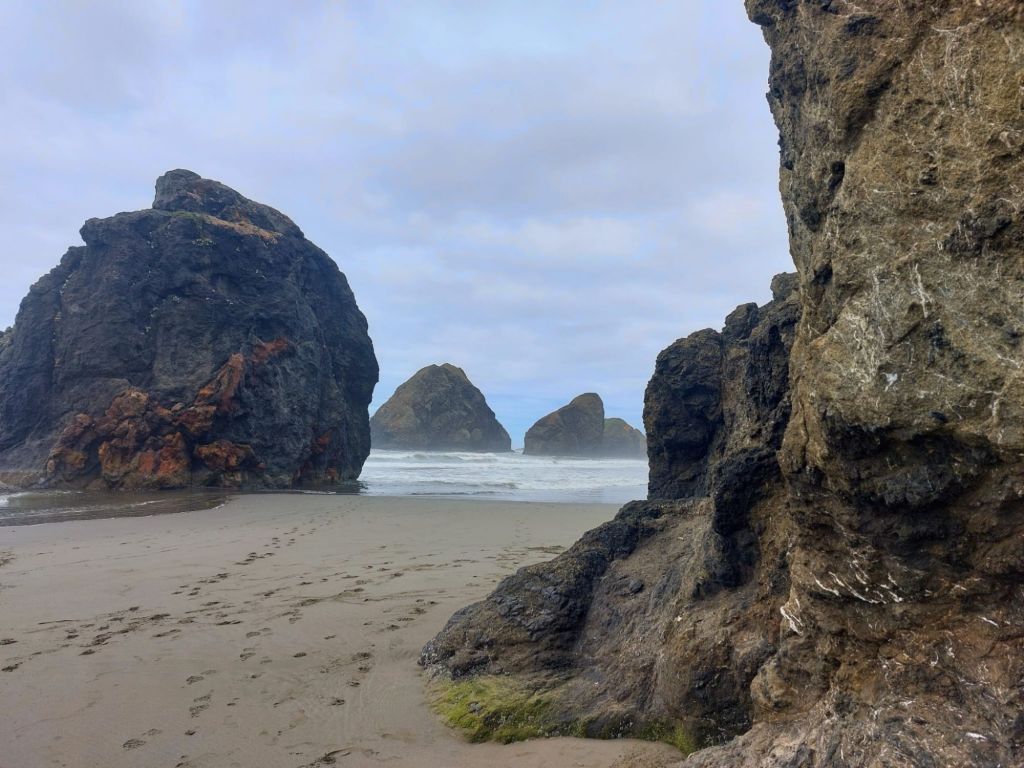
with my sister I walk among giants of rock
on the south coast of Oregon
Angels, old and black,
chant their subduction
the clash of volcanoes, islands
and small continents shoved up against
the continental plate

In Gaza the ruin has not ended
With no thought of beaches
hounded children crouch in tents
Their parents seek just a little flour
for bread

Dear angels of subduction
we set our hands on your vast shoulders
we ask for your strength
we pray against ruin

Before we rose, in the daylight of Gaza
bombs rained on the camps
and demolished		demolished
one father, four children in a tent

One mother is left
and she has no feet

What is this world
What is this crashing
What raided the house of our belonging
left doors swinging on broken hinges
What suffocates us all
What ruin

Dear sentinels, dear Old Ones
we are not strong like you
we need our feet
we need gentleness and food
Dear God in heaven
come to the beaches of Gaza
and the tents, come now

Tell us
how we live in this bombing
or far away from it
with helpless hands

I walk out to one of the giants
lean against its ancient bulk
A wave rolls in over my feet
How do I live
Good Friday worship can awaken a whole raft of emotions: love, gratitude, sorrow—and sometimes rage. In the final weeks of his life, Bonhoeffer wrote, “Christians stand by God in God’s hour of grieving.” What does that mean for us now?
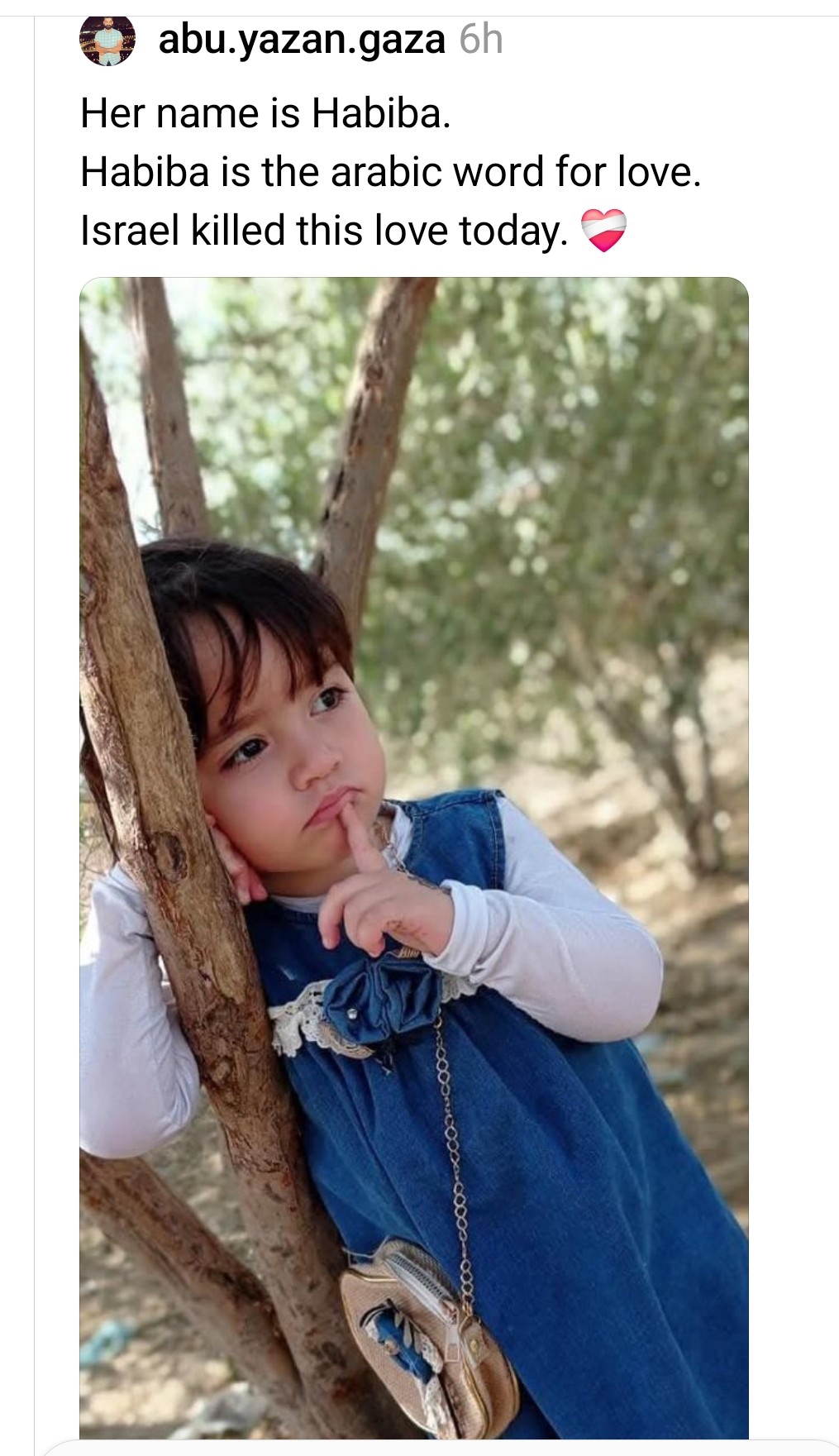
I walked home from church last night in a hot rage. Actually there was a mess of emotions—tender desire to stay awake with Jesus in his suffering; gratitude for the creative devotion of those who had crafted a series of sensory meditations to help us do that; distress over the loss of a beautiful Palestinian girl-child, which I had learned about on social media earlier that evening, and a beautiful Palestinian boy-child’s loss of limbs.
And fury at the broken promises of my country.
In eighth grade I was in the USA with my family, and in home room at Milburn Junior High School that year we were shown jerky films of skin-and-bones survivors of Nazi concentration camps. I will never forget those naked forms of human beings, beloved of God, starved to barely-aliveness. Barely able to walk, weighing barely enough for gravity to hold them to the earth. Those films came with solemn assurances that now we had the United Nations, we had an international system to make sure the Holocaust would never happen again.
Habiba and Mahmoud would beg to differ. The very country that claimed credit for stopping the Holocaust is now supplying the bombs raining down on the tents where their families are taking shelter. And that very country has been blocking the United Nations from putting an end to the genocide.
And it is my country. And many, many of us around the world are desperate to stop the violence, and thus far we have failed.
So I have no Easter platitudes to offer. I will go to church again on Sunday morning, and I’ll take joy in the resurrection story—I will cling to the hope it provides. But in my heart, until Israel’s crazed violence against the Palestinian people and land has been brought to an end, I will keep trying to stay awake with Jesus. Because Jesus is suffering with Mahmoud, and with Habiba’s bereft family, and with all of Palestine.
Habiba’s name means Love. She was killed on Good Friday.
Processing…
Success! You're on the list.
Whoops! There was an error and we couldn't process your subscription. Please reload the page and try again.
This evening as I walked toward Lake Michigan, I suddenly had the thought I’m almost exactly the same age Mom was when she died.
Then I thought, I have the life Mom would have wanted. Well, maybe she wouldn’t have wanted the public protest aspects. But among all my sisters and me, she would see the scope of possibilities she longed for, the freedom to take up space in the world.
As I approached the water, gray aqua and green against gray blue, a song I’d learned for our God’s Love Knows No Borders action came to me. It’s called just “The Wave,” and the songwriter, Miser, performs it as part of a longer song; but others have pulled out just one stanza and one repeated phrase, singing them in counterpoint.
It’s very odd to me, but as I age I become more aware of the ways misogyny has affected me throughout my life, and how I’ve been carrying an underground anger about it. This was where my thoughts turned next. The church in which we girls and women weren’t supposed to voice prayers aloud, even when we had an Easter hat or a Catholic doily pinned to our hair (we tried to obey certain scriptures very literally). The work as a bilingual secretary for $1.75 an hour, from which I was driven home to change clothes the day I wore a perfectly modest dress whose split skirt showed in the back. The husband who said the Bible gave him the right to demand sex on his schedule. The boss who didn’t want to promote me because I was so good at detail work—“you are irreplaceable.”
The resentment was mostly buried for decades. In the contemplation that retirement allows me—you will laugh, please do laugh—it has come into my awareness partly through online mahjong games that I often play. Certain pieces/symbols are masculine in my mind, and I find myself trying to rid the digital board of them as quickly as possible.
I try to keep the flowers and the birds, and to end each game with them. It’s surprising how often I succeed at that.
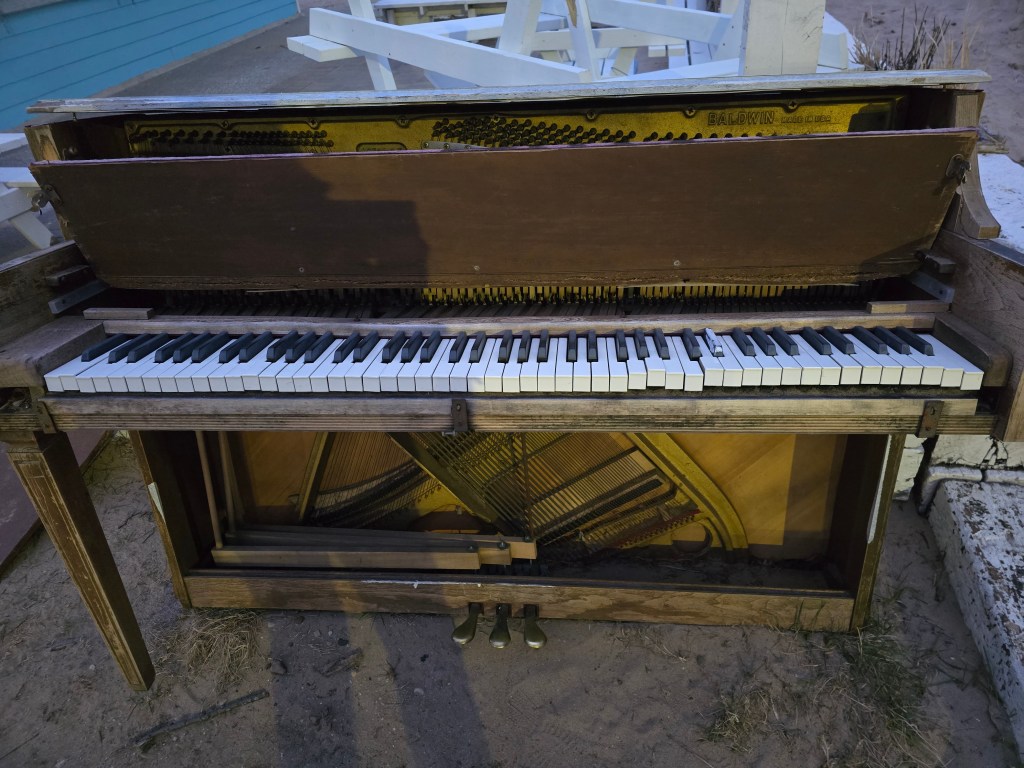
I started singing “The Wave” softly as I walked. And on the way home, there was no one at the beach piano. I found an octave in which most of the keys were not yet stuck, and played it.
So simple, and still one note couldn’t sound, but it was carrying me. Though I’m not sure what the songwriter originally intended, the song is saying to me that the pain and struggle of this time sometimes washes over me like a long wave. But “there will be better days”: waves can also buoy us. We rise and sink, and rise again.
I have happy, warm relationships with my brothers, my son, many male church friends, writers, artists, activists. When I encounter misogyny, I can back away and leave it to God. When it’s expressed against another woman, I can speak up to support her.
Despite the limitations my mother experienced, she had a beautiful, meaningful life, and she never stopped growing. When her time came, she let the wave of death wash over her with peaceful abandon: she knew she was headed toward greater Life. I pray to be like her.
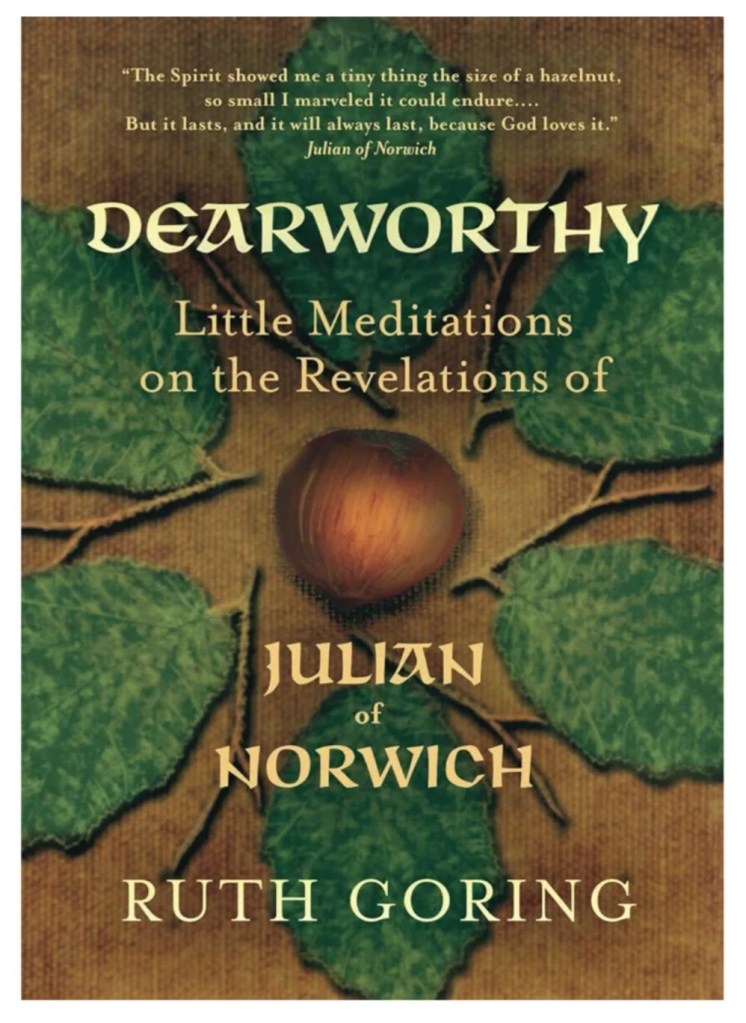
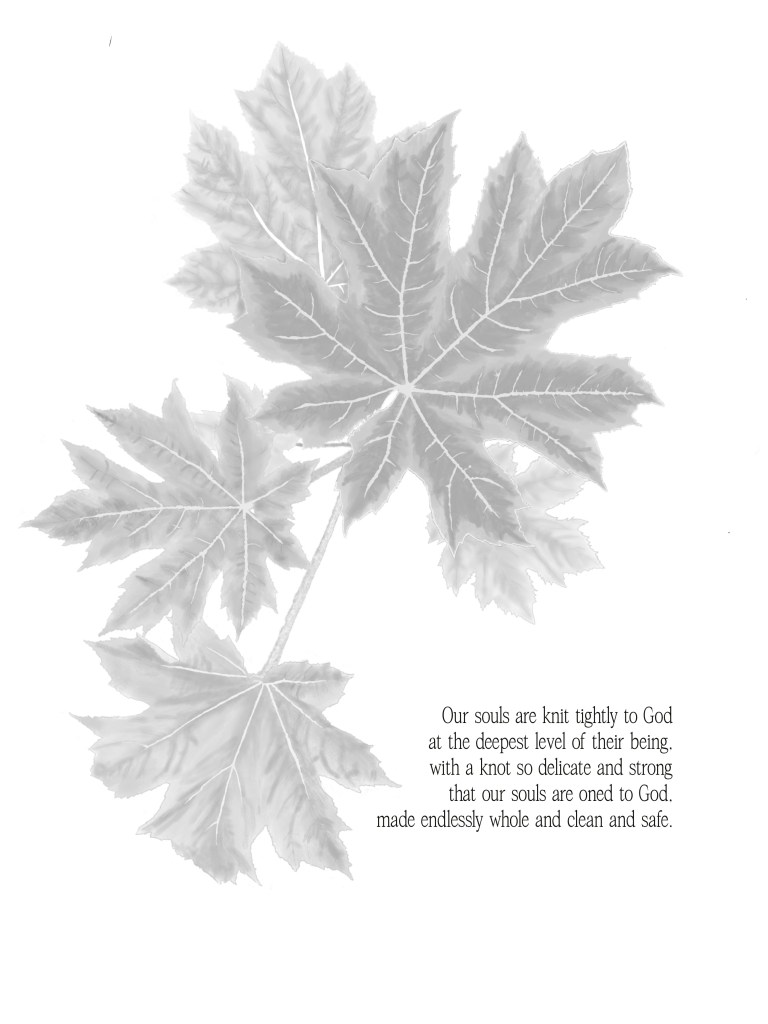
My book has launched! Anyone who has caught sight of me here or on other social media in the past couple of years knows that for a while I’ve been writing and thinking about the medieval Christian mystic Julian of Norwich and creating botanical art to accompany key excerpts from her writings. Now these meditations are available in a lovely little collection published by Anamchara Books.
The work has been a beautiful journey for me: it involved not only learning a lot about Julian but also learning digital art techniques—some via online classes, some by trial and error. All writing is discovery, and this writing led me into my pain and failures but also into breathtaking experiences of the immense and tender love of God.
What does it mean to be “oned” to God? For me it has meant centeredness in God’s steady presence, release from nagging anxieties—and also new freedom to act in public solidarity with God’s beloveds who are suffering. The song that God sings over us is a song of suffering-with, of being-with. It is for sharing, for as Julian says (in Ellyn Sanna’s paraphrase), “The happy comfort revealed to me is big enough for us all.”
On the sad anniversary of Israel’s intensified attacks on Gaza, recognized around the world as a genocidal campaign but supported unconditionally by my own government, I have written a letter that I will be posting in the following online forms. If you feel moral injury as I do, you are welcome to copy and adapt this letter to share with your own electeds. Here are sites for my representatives, along with links you can use to communicate with yours:
Dear President Biden, Vice President Harris, Senator Durbin, Senator Duckworth, Representative Schakowsky:
The Earth has made a complete orbit around the Sun since October 2023, and thanks to all of you, the world has been witnessing the first genocide of the twenty-first century during these twelve months.
As Israel began carrying out its revenge and targeting the civilians of Gaza, you seized the opportunity to assist it with countless lethal weapons, including 2,000lb bombs, which it has used to incinerate refugee camps, killing whole families, and has dropped on other homes and on schools, universities, churches, mosques, markets, and farms. It has targeted water plants and left people drinking fetid water from puddles and ditches. It has committed one war crime after another. Its snipers have gleefully targeted older women like me, its snipers have shot children in the head. Its soldiers film themselves laughing while they humiliate prisoners. These videos have been posted on social media for the whole world to see.
You have wrinkled your faces in expressions of empathy and urged Israel to minimize civilian casualties and investigate a couple of the many reported incidents of human rights abuses. You know full well that Israel will not investigate its misdeeds honestly.
While supposedly waging this assault in the name of freeing the hostages held by Hamas, Israel has killed a number of those hostages, again with US weapons.
About a dozen employees of UNRWA were accused of participating in the October 7 raid or supporting it some way. UNRWA promptly fired those employees. But instead of lauding its quick response, you cut off support for UNRWA, the only source of food for thousands of Gazans, and you influenced other Western governments to do likewise. With trucks carrying aid blocked by Israeli soldiers and settlers at all the crossings, the people of Gaza who have not been killed are starving. They walk the streets like ghosts.
Rep. Schakowsky, months ago you justified voting for a bill that included another huge sale of weapons to Israel with a long statement arguing that it was the only way to get desperately needed food aid to Gaza. Do you not understand that dropping boxes of food is stupendously offensive when you have also provided Gaza’s enemy with massive weapons and artillery to kill those hungry people?
President Biden and Vice President Harris, you claim to be working “tirelessly” for a ceasefire. Surely you are aware that Hamas is not the one putting up obstacles to a ceasefire agreement. It has agreed multiple times to US-backed proposals. Netanyahu’s government is the intransigent party every time. Indeed Israel sent assassins to kill Hamas’s chief negotiator, Ismail Haniyeh, in Tehran. Netanyahu knows that his administration will fall apart if he says yes to a cessation of hostilities. And he has absolutely no positive reason to say yes, given that the United States continues to blithely send weapons at the rate of two shipments every single day.
You are violating multiple US laws each time you send those weapons to Israel. We are under obligation to stop arming any country that commits human rights abuses in its conduct of war. But somehow you see yourselves as above this law.
Emboldened by your encouraging words (“we will never abandon Israel”), Israel has increased its violence in the West Bank. And now Lebanon, Yemen, Iran, Syria . . .
I am deeply ashamed of you as representatives of the country where I vote and pay taxes. You seem blissfully unaware that as you enable the destruction of Gaza and its people, you are also inflicting profound moral injury on the people whom you were elected to serve and represent. Moral injury happens when great evil is done in our name and we are powerless to stop it. The people of the United States do not approve of your support of Israel’s carnage, and we have been letting you know in polls, petitions, phone messages, street protests. But you do not listen to us. In this election season you are probably glad to be running against Trump and all the Project 2025 people, because their plans are so horrific that when we shut our eyes to Gaza, you seem like the good guys. But we know. Even ardent Democrats know that you are injuring us as you wrap yourselves in the Israeli flag. You are injuring the whole world.
Do you remember Aaron Bushnell, the Air Force serviceman who immolated himself in front of the Israeli embassy last February, crying out “Free Palestine”? Did you dismiss his agony because he wasn’t your constituent? Aaron saw your complicity in genocide—a complicity that we all share as taxpayers. You are using our money and you are killing our souls as you arm Israel so that it can starve, torture, and kill the people of Palestine.
I am seventy years old, a mother and grandmother, an artist and writer, a follower of Jesus. I live very modestly but have a rich and beautiful life. And on this anniversary I am contemplating Aaron Bushnell’s action. I am wounded by what you are doing in my name, and I’m wondering what desperate public step I could take to wake you up.
You probably wouldn’t care much because I don’t donate to your campaigns. And since you can see the images of Gazan babies killed by US bombs and you keep sending the bombs anyway, you wouldn’t be moved by any sacrifice I might make. You have political reasons that completely override public or personal ethics.
It is exhausting and heartbreaking to live in the world that you are destroying. But I believe that somewhere in your core, you, like me and like every human being, still have a soul that longs for God and reaches for the good. Will you begin to shut out the political pressures and listen to your own soul? Are you able to reverse course—to repent, to use an apt biblical term? You don’t have to stop being a politician: you could actually start listening to your constituents and help to assuage our moral injury. You could uphold US law and impose an arms embargo. You could save dollars that way and direct them toward reparations for the people of Gaza and meeting urgent needs for healthcare, education, and housing here in the USA.
You could. Will you?
In grief and necessary hope,
Ruth Goring
Chicago police gathered around me in June 2024 as I lay shrouded on Franklin Street in front of the building where AIPAC has its local office. Along with ten others, I chose arrest and jail in order to make vivid the deadly consequences for Gaza of our country’s unethical Middle East policies.
In my recent meditations on the writings of Julian of Norwich, I have relished her prolonged contemplation of Jesus as our Mother: how he gives birth to us twice, in creation and on the cross, and how he tends us day by day.
Who describes Jesus’s mothering of us better than Julian? My botanical illustration is of serviceberries on a tree near my home.
Julian’s trinitarian theology is clear and sound: the three Persons are One, and what is done by any of them is done by the one God. What one Person is, all three are together. Thus in other places she writes that God is both Father and Mother.
To my sorrow, I remember as a young adult scoffing along with a friend who had visited a “liberal” church where prayers were often addressed to “Father-Mother God.” Now I think such forms of address are true and rich, fully consonant with scripture and various strains of Christian tradition.
In my own prayer life I have tended in the past couple of decades to opt for “God”—usually “dear God”—as a gender-neutral term of address. But I’ve been longing for something warmer, a phrase that expresses more of who God is to me, to us.
Daneen Akers makes an excellent case for switching to “Mother God” and ditching the male terms and pronouns altogether. Of course she’s not the only advocate for this; on the page I’ve linked, you can download a helpful PDF she put together quoting other thoughtful Jesus followers who have made this change.
Somehow my heart has been wanting a term that clashes a little more, calling attention to itself, yet one that could come to feel natural on my tongue. This past weekend I hit upon “Mother Lord,” and it feels just right. Lord has a feudal feel, but it’s what the biblical translators continue to use, and its Aramaic equivalent was what the first disciples called Jesus most often. I like retaining this familiar title because it conveys honor and trust and glory. And I have used it all my life.
As a child I called my mother Mommy, and as a teen I switched to Mom. Mother feels different, larger. It speaks of intimacy and belovedness, respect and dignity. Our Lord is Mother to me and to my mother and father, to all generations of humankind. She is our Source, giving us life, tending us, challenging us, calling us home.
“Mother Lord” makes me chuckle a little, and it seems to hold my whole ongoing journey to know God more.
Giving God names that reflect our awe and affection is a very scriptural thing to do. Have you come up with a special name for God? I would love to read it.
For a few years now I have been pondering the words of Julian of Norwich, the medieval woman who at age 30 received a series of “showings” or revelations of the love of God. She dedicated the rest of her life to praying through these visions, asking God questions about them, deciphering their meaning. In fact after she wrote them down, she began writing them again as she understood more.
Julian moved into a small anchorhold–a monastic cell built against a wall of St. Julian’s Church in the city of Norwich, England. Another woman lived in an adjoining cell and took care of her practical needs so that Julian could live as an anchorite, mostly in solitude for prayer and writing but in the afternoons receiving visitors who came to her porch window to seek her counsel.
I feel a great kinship with Julian, not because I possess comparable wisdom and dazzling intellect but because I too have had deep experiences of God’s love. Julian’s insights speak to my heart. They are carrying me through these years of terrifying climate change and pandemic and war and the violence of white supremacy. Julian is an older sister who holds my hand, grieves with me, and helps persuade my anxious body to rest in love.
The title I chose for this post is from an extended meditation on a brief vision Julian received. A lord (remember, she lived in medieval England) is sitting on a throne with a servant nearby. The lord asks the servant to take care of a certain task, and the young man leaps up to obey–but immediately stumbles and falls. Instead of berating him for his awkwardness, the lord descends from the throne and kindly takes his hand to help him up.
Julian is fascinated by this parable/vision and spends several pages interpreting it. The lord, of course, is God, and the servant is the paradigmatic human being, Adam. The first sin committed by the first humans in the book of Genesis has long been called “the fall.” But Julian is moved and astonished to see how gently God responds to Adam’s offense. This was not the God portrayed in most church sermons in her day.
Julian shares other insights as she digs into this parable–too much to explain here. What I’ve been carrying around in the notes app on my phone is one phrase: within the lord she sees “a great refuge, long and wide and full of endless heavens.”
Every time I read it, I must stop and take a deep, glad breath.
God is some kind of a river, some kind of a sky, some kind of a forest in which every vulnerable created thing is welcomed and protected.
My last post hinted at the wild conversations that can happen with children when bedtime is filled with songs, stories, and prayers. My own kids shared a bedroom for years because of a tight budget, so our bedtime ritual involved them together. Many of our most important conversations happened during those years.
No topic was forbidden. My children’s defenses would be down, and sometimes they’d blurt out rather extraordinary things.
Claire: Why do angels always carry torches?
Mom: I didn’t know they did. Have you seen an angel?
Claire: Yeah, the other day I ran around the corner of Andrew’s house and there was an angel.
Mom: Oh wow, did you talk?
Claire: Yeah. I told him I was sorry for saying bad words.
As a missionary kid and InterVarsity Christian Fellowship alum, I’m stuck for life with an internal theology monitor. My invisible antennas went up as my daughter spoke. Claire’s angelic encounter seemed to pass scriptural tests: it was unexpected and it prompted repentance. I couldn’t recall any Bible story book illustrations of angels carrying torches (for Brits, flaming torches, not flashlights). But the mental image is beautiful, and completely consonant with biblical imagery.
After singing Christmas carols, before we trooped up to their room for the rest of bedtime.
It was at bedtime that my children told me—together—that they’d decided they wanted to be baptized.
It was at bedtime that they told me they hoped a family member traveling abroad would die instead of coming home.
It was at bedtime that they told me they’d conferred with each other and agreed that they hoped a family member traveling abroad would die instead of coming home. I held in my shock and did not reproach them but asked why. Their answer was a revelation to me, helping me understand that the family environment needed to be made safer for them.
Some years later, when my kids had their own rooms, Graham and I had a bedtime conversation and prayer very like that in Isaiah and the Worry Pack. It was a God-encounter for both of us. A week or so later, I asked him how his sleep had been. “OK,” he said. “If I’m having trouble sleeping, I just run a mini-version of ‘The Worry Pack’ like a video in my mind.”
That was when the thought came to me that perhaps someday I should make our experience into a book.
Claire was in junior high when she told me at bedtime that some peers at school made fun of a disabled classmate and she had joined in. Later, on her own initiative, she had apologized tearfully to the girl, and they became friends.
Finally, there were the daytime conversations that emerged from our bedtime sharing. One fall afternoon when Claire was three, we were driving in the neighborhood and I called her attention to a small maple tree whose leaves were afire. “Isn’t it gorgeous?” I rhapsodized.
Claire burst out from the backseat, “I love God!”
Bedtime talks and readings had formed her to see the world theologically, as made and sustained by God.
My children were no more creative than the children in your life are; they had no more capacity for entering God’s presence than your children have. So as you wake up to God’s love and learn new, fruitful ways to pray, share your experiences with them. Of course what you share needs to be at their level, and it needs to connect naturally with their lives and struggles.
There’s no telling what new adventures you’ll have together. And sometimes you’ll find your young ones leading the way.
Praying with children is one of the most important things we can do to foster their life with God.
My kids and I prayed before meals throughout their growing-up years, and spontaneously anytime they were hurt, frightened, or sick. But the most important time for prayer was bedtime. After I read a picture book or a middle-grade book chapter to them, and a Bible story, we took turns praying. Then I sang something peaceful as they drifted off to sleep. This practice calmed and nurtured all of us and bore sometimes surprising fruit.
Our routine was modeled on my own experiences growing up in a large family with missionary/teacher parents.
Prayer in the Land of Gorings
Not all those early experiences of prayer were nourishing. Our dad would periodically decide to lead family devotions following breakfast. It always fell flat—I can’t remember a single time that morning devotions didn’t feel awkward and pedantic, with Dad posing schoolroom-type questions that failed to engage our lives or our struggles. The practice always petered out after a few dutiful stabs at this perceived obligation.
Bedtime prayers were a whole other story. For years—beginning in our eldest sister’s infancy—little Gorings gathered in PJs each night for the enchantment of a poem or two read aloud, followed by a story or book chapter, a Bible story, humorous songs and a hymn or two, and finally prayers. It was our warmest time together; it grew our imaginations and helped to form an indelible family culture that keeps my siblings and me deeply bonded to this day. We have all remained in the faith.
Arrayed in our pajamas just before going to bed and starting the nightly ritual. That’s me on the left. Three more siblings were yet to come! And then my parents adopted two more when the rest of us had grown into young adults.
Bedtime is best
What makes bedtime a particularly rich time to pray with our little ones? I think there are a couple of reasons.
First, as they become sleepy children’s normal defenses go down. Especially if the parent is unhurried and attentive at bedtime, children may get in touch with tender or sad feelings and blurt out things they’d not say in daylight.
It is a gift just to find words for our feelings and experiences. Then they can be brought to God in prayers of thanksgiving and petition.
Two favorite photos of my kids in childhood
Second, bedtime is a natural time to think back on the day and look forward to what is coming. Cindy Bunch’s Be Kind to Yourself (IVP, 2020) wasn’t around when I was a young mom, but if it had been, I’m pretty sure I would have used its simple examen questions—what’s bugging you? what’s bringing you joy?—to help my kids articulate hardships of the past day and places where they had sensed God’s presence.
Kid-friendly prayers
Prayer with children can take other forms too. My picture book Isaiah and the Worry Pack (IVP Kids, 2021) models an imaginative way of meeting God through guided imagery. It’s based on an experience my son Graham and I had together one night when he struggled with some big worries. Jared Patrick Boyd suggests ways to pray Scripture imaginatively with children in Imaginative Prayer (IVP, 2017).
Memorized prayers can be helpful too. When I was a child, we often recited “Now I Lay Me.” Its mention of death would make it off-putting to many parents nowadays. But falling asleep is entering another country, mysterious and affording children even less control than they have over their waking hours. Maybe it’s not so bad to provide our kids a prayer that contains their fears within a little rhyme that expects God to hold them in both waking and sleeping, living and dying.
Some lovely prayers to read and perhaps memorize with kids—in daytime as well as at bedtime—can be found in Traci Smith’s Prayers for Faithful Families (Beaming Books, 2020). And a great resource is coming soon from IVP Kids: Little Prayers for Ordinary Days by Tish Harrison Warren, Flo Paris Oakes, and Katy Hutson (2022).
Singing as prayer
Singing can be a prayer practice too, of course. I adopted my daughter Claire at age one after she had suffered serious neglect and starvation in an institution during her first six months of life. As she grew, she became especially fond of the hymn “Children of the Heavenly Father.” For years she requested it practically every night, along with prayers that she wouldn’t have bad dreams.
Claire at 18 months, now in the US, with my mother, Susy Goring, who had literally rescued her from death.
Years later Claire was at the National Registrar’s office in her birth country, Colombia. She’d entered to apply for her identity card so that her dual citizenship could be recognized. An encounter with the director of the new digital population database led to an amazing bonus: printouts of the birth, ID, and death records of her birth mother!
Holding these documents, Claire wandered out onto Plaza Bolívar toward the national cathedral while waiting for a friend to complete an errand of her own.
Then from inside the huge church she heard music—the organist at this Colombian Roman Catholic cathedral dedicated to the Sacred Heart of Jesus began playing a Swedish Lutheran hymn, “Children of the Heavenly Father.”
Claire told me later that her heart began pounding in surprised awe. But she was also flooded with peace. Even though she’d just learned that she’d never meet her birth mother in this life, she might be able to track down other members of her biological family, now that she had her mom’s documents. And the hymn reminded her that the gentle, attentive Father she had met in bedtime prayers would be with her. All along God had been bearing her, as the hymn says, “in his mighty arms.”
Note: I have many stories of funny and extraordinary conversations about God that arose out of prayers with my kids. Too many to tell in one post! So I welcome you to subscribe (above right, next to the title of this post) if you’d like to read them in the coming weeks.
As Isaiah & the Worry Pack‘s launch day draws near–just 11 days from now!–I’ve been happily busy with writing and interviews about this book, worry/anxiety experienced by children, prayer, and my kids’ books more generally.
I’ve thought again and again of an experience during Lent 1991 in a little church in West Chicago. I had been introduced to guided-imagery meditation before then, through books and a therapist, but on this Wednesday night it changed my life.
My first (sad and abusive) marriage had ended, and I still wondered whether divorce was one of the worst sins, essentially a departure from the faith in which I had grown up. I had moved my kids across the country, and now I was in a church service with a bunch of strangers. The woman at the front invited us to close our eyes and participate in a prayer exercise called Garden of the Heart.
Picture your heart as a garden.
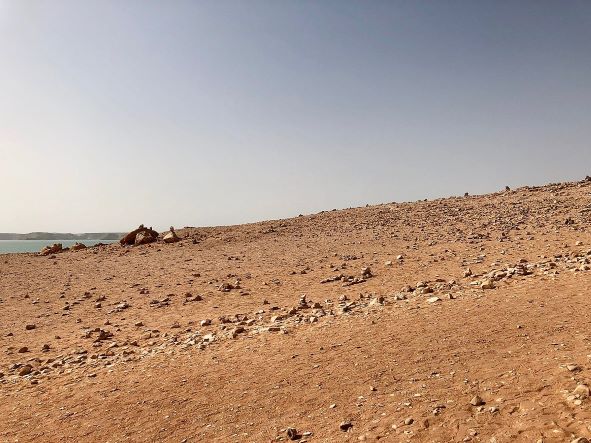
Mine isn’t even full of weeds. It is a patch of dry, hard, absolutely barren dirt.
My heart was rather like this barren ground at Abu Simbel, Egypt. Photo from Creative Commons.
Where are you in the garden?
Right in the middle, lying prostrate with my face in the dirt.
Now Jesus comes into the garden. What does he do?
I suppose he picks up a hoe and starts poking at the dirt to break it up for planting.
No! I see Jesus. He is right beside me on the ground, face down in the dirt.
I cried and cried that night—healing tears. God had come into my devastation, my life’s failure, and instead of hurrying to fix things was mourning with me.
My inner desert had become a place of intimate encounter—a garden for the sprouting of something beautiful, unforeseen, and utterly wild.








 Ruth Goring