
This evening as I walked toward Lake Michigan, I suddenly had the thought I’m almost exactly the same age Mom was when she died.
Then I thought, I have the life Mom would have wanted. Well, maybe she wouldn’t have wanted the public protest aspects. But among all my sisters and me, she would see the scope of possibilities she longed for, the freedom to take up space in the world.
As I approached the water, gray aqua and green against gray blue, a song I’d learned for our God’s Love Knows No Borders action came to me. It’s called just “The Wave,” and the songwriter, Miser, performs it as part of a longer song; but others have pulled out just one stanza and one repeated phrase, singing them in counterpoint.



It’s very odd to me, but as I age I become more aware of the ways misogyny has affected me throughout my life, and how I’ve been carrying an underground anger about it. This was where my thoughts turned next. The church in which we girls and women weren’t supposed to voice prayers aloud, even when we had an Easter hat or a Catholic doily pinned to our hair (we tried to obey certain scriptures very literally). The work as a bilingual secretary for $1.75 an hour, from which I was driven home to change clothes the day I wore a perfectly modest dress whose split skirt showed in the back. The husband who said the Bible gave him the right to demand sex on his schedule. The boss who didn’t want to promote me because I was so good at detail work—“you are irreplaceable.”
The resentment was mostly buried for decades. In the contemplation that retirement allows me—you will laugh, please do laugh—it has come into my awareness partly through online mahjong games that I often play. Certain pieces/symbols are masculine in my mind, and I find myself trying to rid the digital board of them as quickly as possible.
I try to keep the flowers and the birds, and to end each game with them. It’s surprising how often I succeed at that.
I started singing “The Wave” softly as I walked. And on the way home, there was no one at the beach piano. I found an octave in which most of the keys were not yet stuck, and played it.
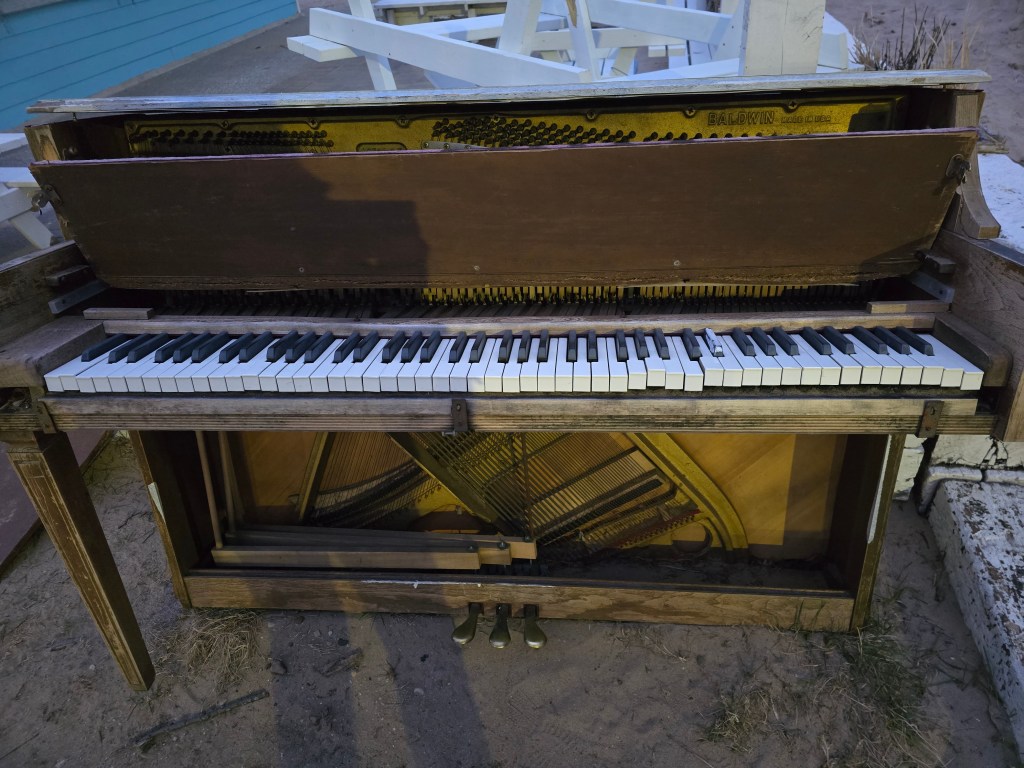
So simple, and still one note couldn’t sound, but it was carrying me. Though I’m not sure what the songwriter originally intended, the song is saying to me that the pain and struggle of this time sometimes washes over me like a long wave. But “there will be better days”: waves can also buoy us. We rise and sink, and rise again.
I have happy, warm relationships with my brothers, my son, many male church friends, writers, artists, activists. When I encounter misogyny, I can back away and leave it to God. When it’s expressed against another woman, I can speak up to support her.
Despite the limitations my mother experienced, she had a beautiful, meaningful life, and she never stopped growing. When her time came, she let the wave of death wash over her with peaceful abandon: she knew she was headed toward greater Life. I pray to be like her.






 Ruth Goring