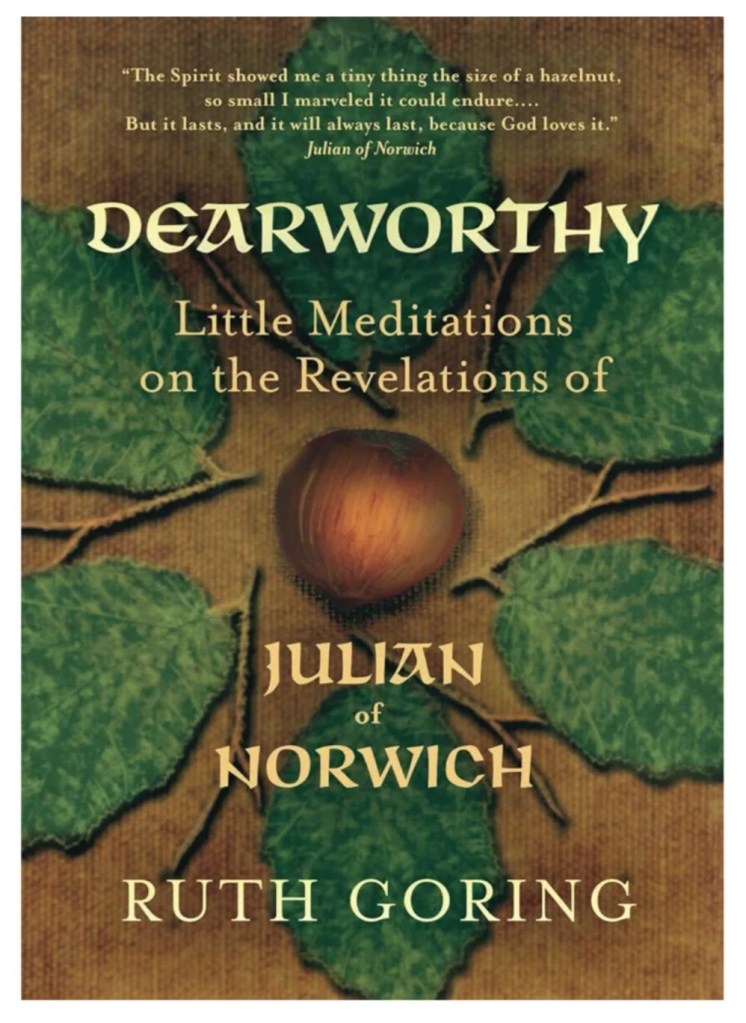
My book has launched! Anyone who has caught sight of me here or on other social media in the past couple of years knows that for a while I’ve been writing and thinking about the medieval Christian mystic Julian of Norwich and creating botanical art to accompany key excerpts from her writings. Now these meditations are available in a lovely little collection published by Anamchara Books.
The work has been a beautiful journey for me: it involved not only learning a lot about Julian but also learning digital art techniques—some via online classes, some by trial and error. All writing is discovery, and this writing led me into my pain and failures but also into breathtaking experiences of the immense and tender love of God.
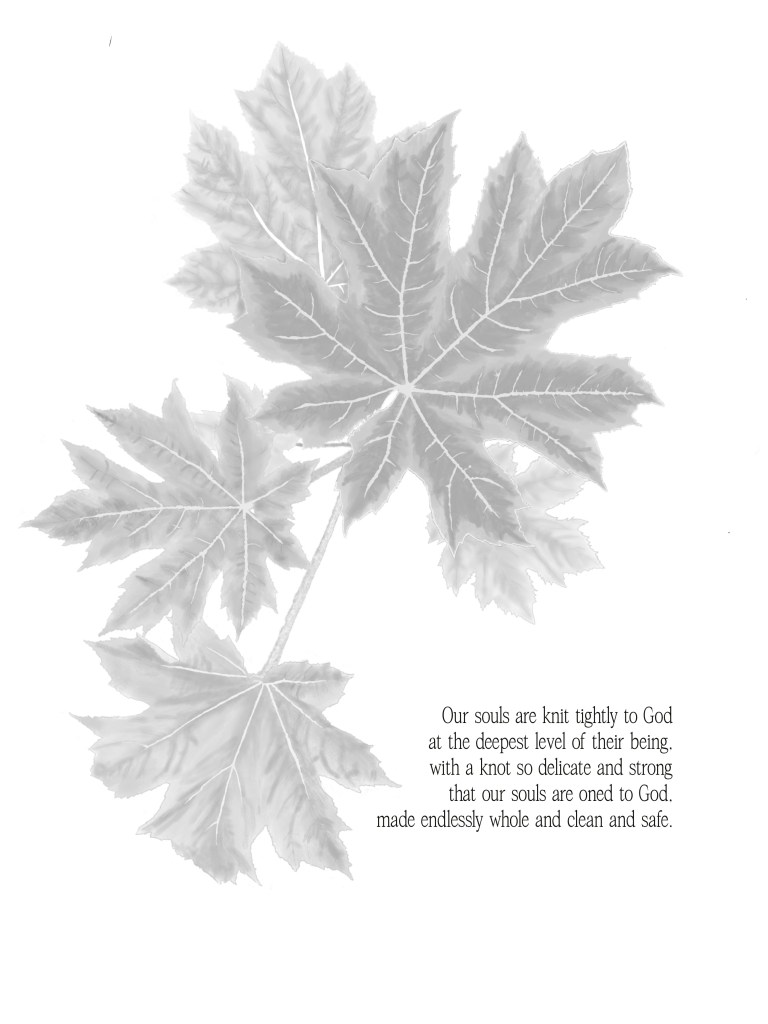
What does it mean to be “oned” to God? For me it has meant centeredness in God’s steady presence, release from nagging anxieties—and also new freedom to act in public solidarity with God’s beloveds who are suffering. The song that God sings over us is a song of suffering-with, of being-with. It is for sharing, for as Julian says (in Ellyn Sanna’s paraphrase), “The happy comfort revealed to me is big enough for us all.”
For a good while now in my newsletter and on my Instagram page, I have been exploring Julian of Norwich’s wisdom via botanical images and short meditations. Because the phrase for which she is principally known—“all shall be well”—can easily become sentimental, I’ve been slow to write about it. But I have thought about it, a lot, and the time has come to take it up. And to write about this in a longer form seems important.
First, the word well. Julian uses it frequently to express her desire for the world, so I looked up the etymology—she wrote six and a half centuries ago, after all! Well in her day was understood to mean abundant, as desired, satisfying, lacking nothing. Julian was essentially seeking the Hebrew state of shalom: peace, well-being, healthy relationships, love.
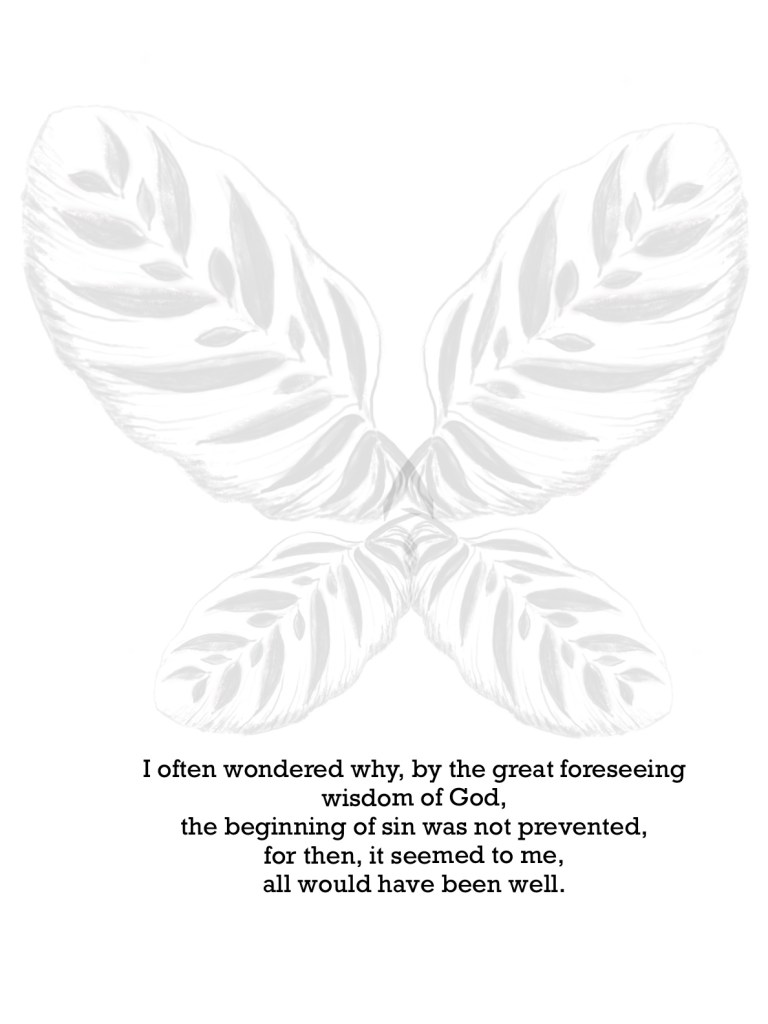
Julian asks God about wellness for the world more than once. How can things become well, when evil seems to permeate the world so thoroughly? Wouldn’t all have been well if sin had been prevented in the first place? Couldn’t God have thrown up an impenetrable barrier against it?
To accompany Julian’s question, I drew a single leaf from the peacock plant. Peacock leaves display a striking green and white pattern, as if painted. In my drawing I repeat the leaf in a symmetrical arrangement to symbolize what my own mind wishes for: perfection as symmetry, clean and free of blemishes or suffering. Julian longed for such innocence and worried hard over God’s reasons for allowing sin. “I ought much to have given up this disturbing wondering,” she admits ruefully, “but nevertheless, I made mourning and sorrow about it without reason or discretion.”
I’m glad the questions troubled her. They trouble me too. I will never forget one night in my young adulthood when, having learned of a Colombian baby born with a genetic abnormality that caused chronic pain, I tossed, turned, and wept in bed. The child was receiving tender care at my parents’ foster home, but still, how could a good God have allowed this? How could God ever make it up to little Diana?
You may well have endured a night like that. Or a day, or a week, or many months. You may be Diana, suffering incurable chronic pain.
How can all be well?
* * *
I was tempted to leave the question hanging and try to do justice to “all shall be well” in a later post. But I won’t. Here’s how I understand God’s response to Julian’s anguished cry.
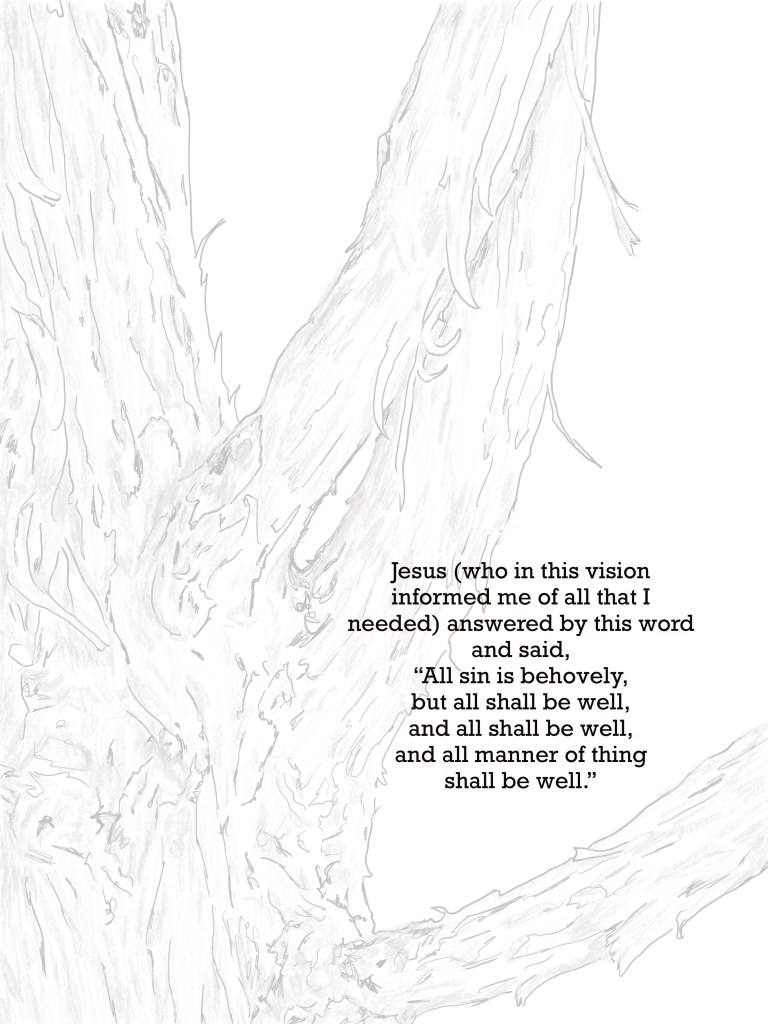
I chose to draw part of a bald cypress tree in late autumn to accompany the words Julian heard Jesus say. I think you’ll see why.
Jesus tells Julian that sin is “behovely.” I retained this Middle English word because there’s some discussion among translators about its meaning. The phrase “it behooves us to ____” incorporates a more recent version of the term: we need to do x, it is the right thing to do. Behovely could mean necessary. It could mean appropriate. The late Father John-Julian, whose Julian translation I’ve been adapting, chose inevitable here.
Jesus doesn’t answer the how-question directly, but he seems to be saying that sin (which has no being in itself but is parasitic on God’s good creation) is an occasion of something beautiful. Because of Adam and Eve’s fall, the Second Person of the Trinity fell into the creation and identified with its suffering, becoming the Child of Humanity. The story of God’s involvement with the world is still being told. It is a story of redemption, of movement toward shalom.
The Lord doesn’t say shalom, of course. Jesus uses Julian’s own word, well. I find it sweet that Mother God offers Julian this mirroring, the way a human mother repeats her toddler’s words to affirm them and maybe help the child to pronounce them clearly.
Julian has rebuked herself for her desperate struggle, but Mother God does not scold her. Quite the opposite.
Your desire is good, Mother God is saying. It is my very purpose. The promise is never conditional: indeed all shall be well—abundant, lacking nothing, satisfying.
* * *
Julian’s earlier showings include strange and gruesome visions of Jesus’s sufferings on the cross. I am not drawn to those images, but Julian found them marvelous and comforting. I think she was able to believe God’s assurances of wellness—well-being and restoration of all that is damaged—because she had seen Jesus suffering with us.
The healing of all things does not involve a magic wand. It’s not the detached action of a god who is playing a cosmic game. Jesus suffered damage just as we do. The need for things to be well is personal for Julian’s Lord.
The “when” that goes unvoiced in Julian’s question is implicitly eschatological, and another day I will write about her blazing insight into the Last Things. For now, let’s simply burrow into the promise.
All shall be well, and all shall be well. And all manner of thing shall be well.
Oh child, Mother God says. Your desire is not too much for me. You don’t even know how much and how many things need to be set right, to be brought into wellness. It is more than you can ask or imagine. I promise you, though, that restoration is for all. Not just for humans, not even just for creatures that breathe. Every kind of every thing shall be well.
If you want to explore Julian’s theology further, I highly recommend Amy Frykholm’s May 2023 article “Julian the Theologian.” And there are more writings and podcasts to check out on my Julian’s Porch page (see menu).
Sign up for my newsletter!
Processing…
Success! You're on the list.
Whoops! There was an error and we couldn't process your subscription. Please reload the page and try again.
In my recent meditations on the writings of Julian of Norwich, I have relished her prolonged contemplation of Jesus as our Mother: how he gives birth to us twice, in creation and on the cross, and how he tends us day by day.
Who describes Jesus’s mothering of us better than Julian? My botanical illustration is of serviceberries on a tree near my home.
Julian’s trinitarian theology is clear and sound: the three Persons are One, and what is done by any of them is done by the one God. What one Person is, all three are together. Thus in other places she writes that God is both Father and Mother.
To my sorrow, I remember as a young adult scoffing along with a friend who had visited a “liberal” church where prayers were often addressed to “Father-Mother God.” Now I think such forms of address are true and rich, fully consonant with scripture and various strains of Christian tradition.
In my own prayer life I have tended in the past couple of decades to opt for “God”—usually “dear God”—as a gender-neutral term of address. But I’ve been longing for something warmer, a phrase that expresses more of who God is to me, to us.
Daneen Akers makes an excellent case for switching to “Mother God” and ditching the male terms and pronouns altogether. Of course she’s not the only advocate for this; on the page I’ve linked, you can download a helpful PDF she put together quoting other thoughtful Jesus followers who have made this change.
Somehow my heart has been wanting a term that clashes a little more, calling attention to itself, yet one that could come to feel natural on my tongue. This past weekend I hit upon “Mother Lord,” and it feels just right. Lord has a feudal feel, but it’s what the biblical translators continue to use, and its Aramaic equivalent was what the first disciples called Jesus most often. I like retaining this familiar title because it conveys honor and trust and glory. And I have used it all my life.
As a child I called my mother Mommy, and as a teen I switched to Mom. Mother feels different, larger. It speaks of intimacy and belovedness, respect and dignity. Our Lord is Mother to me and to my mother and father, to all generations of humankind. She is our Source, giving us life, tending us, challenging us, calling us home.
“Mother Lord” makes me chuckle a little, and it seems to hold my whole ongoing journey to know God more.
Giving God names that reflect our awe and affection is a very scriptural thing to do. Have you come up with a special name for God? I would love to read it.
For a few years now I have been pondering the words of Julian of Norwich, the medieval woman who at age 30 received a series of “showings” or revelations of the love of God. She dedicated the rest of her life to praying through these visions, asking God questions about them, deciphering their meaning. In fact after she wrote them down, she began writing them again as she understood more.
Julian moved into a small anchorhold–a monastic cell built against a wall of St. Julian’s Church in the city of Norwich, England. Another woman lived in an adjoining cell and took care of her practical needs so that Julian could live as an anchorite, mostly in solitude for prayer and writing but in the afternoons receiving visitors who came to her porch window to seek her counsel.
I feel a great kinship with Julian, not because I possess comparable wisdom and dazzling intellect but because I too have had deep experiences of God’s love. Julian’s insights speak to my heart. They are carrying me through these years of terrifying climate change and pandemic and war and the violence of white supremacy. Julian is an older sister who holds my hand, grieves with me, and helps persuade my anxious body to rest in love.
The title I chose for this post is from an extended meditation on a brief vision Julian received. A lord (remember, she lived in medieval England) is sitting on a throne with a servant nearby. The lord asks the servant to take care of a certain task, and the young man leaps up to obey–but immediately stumbles and falls. Instead of berating him for his awkwardness, the lord descends from the throne and kindly takes his hand to help him up.
Julian is fascinated by this parable/vision and spends several pages interpreting it. The lord, of course, is God, and the servant is the paradigmatic human being, Adam. The first sin committed by the first humans in the book of Genesis has long been called “the fall.” But Julian is moved and astonished to see how gently God responds to Adam’s offense. This was not the God portrayed in most church sermons in her day.
Julian shares other insights as she digs into this parable–too much to explain here. What I’ve been carrying around in the notes app on my phone is one phrase: within the lord she sees “a great refuge, long and wide and full of endless heavens.”
Every time I read it, I must stop and take a deep, glad breath.
God is some kind of a river, some kind of a sky, some kind of a forest in which every vulnerable created thing is welcomed and protected.


 Ruth Goring