In our time, the beast is money, racism, and domination.
The way of the beast is not the way of Jesus.
This coming Sunday I will be leading worship in our very multicultural church here in Chicago. And it happens that we are making our way through the book of Revelation, and chapter 13 is our surreal text this coming week.
I confess that it has been quite a while since I’ve read through the whole book of Revelation. But chapter 13’s account of the dragon and the beasts made sense to me immediately as I reread it today.
When you are thinking and praying every day about a genocide involving bombing, sniping, and starvation of children, women, and men with your country’s tax dollars,
and the many people around the world who care have not been able to stop it,
putrid beasts with ten horns, seven heads, and seemingly boundless power seem appropriate as representations of such massive evil.
One of the beast’s heads has been killed but the wound has healed over? I picture it flopping on its neck as the beast lumbers along, one of its dead eyes open and staring.
I wonder whether some of the heads have one horn and others two. Horns in scripture are symbolic of power and strength. The power here is utterly malevolent, and it has multiple manifestations.
We already know from earlier chapters that evil is conquered only by the Lamb who was slain—that is, by Jesus, through whom God entered our suffering and went all the way into death and hell for the world’s salvation. In chapter 13 the writer warns us that the evil of our day (the time of the original audience, but also our own) will sometimes be so vile and entrenched as to seem invincible. But Jesus’ victory-through-suffering still stands, and we must stay centered in that Love.
Because our congregation includes a whole range of literacy and education levels as well as multiple languages, after Revelation 13:1-8, 10b is read, a couple of the pastors and I are going to read out the following explanation in English, Nepali, and Kinyarwanda:
In every culture there are stories of dragons and other beasts: powerful forces that are hard to understand and to oppose.
Revelation 13 uses the language of beasts to picture the powers of this world.
This beast has seven heads and ten horns. It is scary!
The writer of Revelation is showing us the powerful evil in the world system.
In our time, the beast is money, racism, and domination.
The way of the beast is not the way of Jesus.
We are surrounded by the beast and its power, but we choose the way of Jesus.
We choose peace and justice, endurance and faithfulness.
When we pray for Gaza, Congo, Sudan, and other places where people are suffering, we are praying against the beast.
It is a long, hard battle, but Jesus triumphs through his life, death, and resurrection.
Good Friday worship can awaken a whole raft of emotions: love, gratitude, sorrow—and sometimes rage. In the final weeks of his life, Bonhoeffer wrote, “Christians stand by God in God’s hour of grieving.” What does that mean for us now?
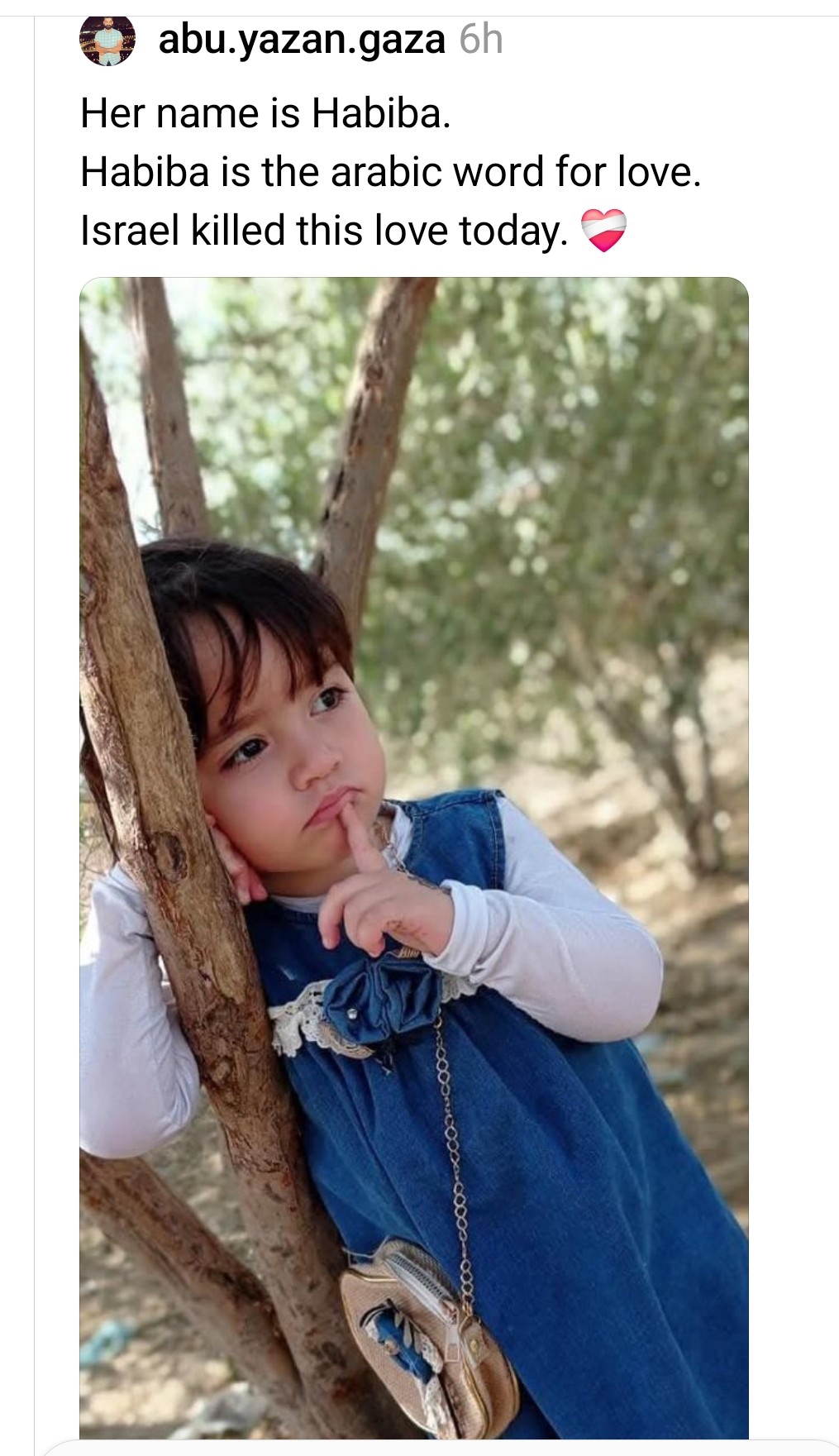
I walked home from church last night in a hot rage. Actually there was a mess of emotions—tender desire to stay awake with Jesus in his suffering; gratitude for the creative devotion of those who had crafted a series of sensory meditations to help us do that; distress over the loss of a beautiful Palestinian girl-child, which I had learned about on social media earlier that evening, and a beautiful Palestinian boy-child’s loss of limbs.
And fury at the broken promises of my country.
In eighth grade I was in the USA with my family, and in home room at Milburn Junior High School that year we were shown jerky films of skin-and-bones survivors of Nazi concentration camps. I will never forget those naked forms of human beings, beloved of God, starved to barely-aliveness. Barely able to walk, weighing barely enough for gravity to hold them to the earth. Those films came with solemn assurances that now we had the United Nations, we had an international system to make sure the Holocaust would never happen again.
Habiba and Mahmoud would beg to differ. The very country that claimed credit for stopping the Holocaust is now supplying the bombs raining down on the tents where their families are taking shelter. And that very country has been blocking the United Nations from putting an end to the genocide.
And it is my country. And many, many of us around the world are desperate to stop the violence, and thus far we have failed.
So I have no Easter platitudes to offer. I will go to church again on Sunday morning, and I’ll take joy in the resurrection story—I will cling to the hope it provides. But in my heart, until Israel’s crazed violence against the Palestinian people and land has been brought to an end, I will keep trying to stay awake with Jesus. Because Jesus is suffering with Mahmoud, and with Habiba’s bereft family, and with all of Palestine.
Habiba’s name means Love. She was killed on Good Friday.
Processing…
Success! You're on the list.
Whoops! There was an error and we couldn't process your subscription. Please reload the page and try again.
For a good while now in my newsletter and on my Instagram page, I have been exploring Julian of Norwich’s wisdom via botanical images and short meditations. Because the phrase for which she is principally known—“all shall be well”—can easily become sentimental, I’ve been slow to write about it. But I have thought about it, a lot, and the time has come to take it up. And to write about this in a longer form seems important.
First, the word well. Julian uses it frequently to express her desire for the world, so I looked up the etymology—she wrote six and a half centuries ago, after all! Well in her day was understood to mean abundant, as desired, satisfying, lacking nothing. Julian was essentially seeking the Hebrew state of shalom: peace, well-being, healthy relationships, love.
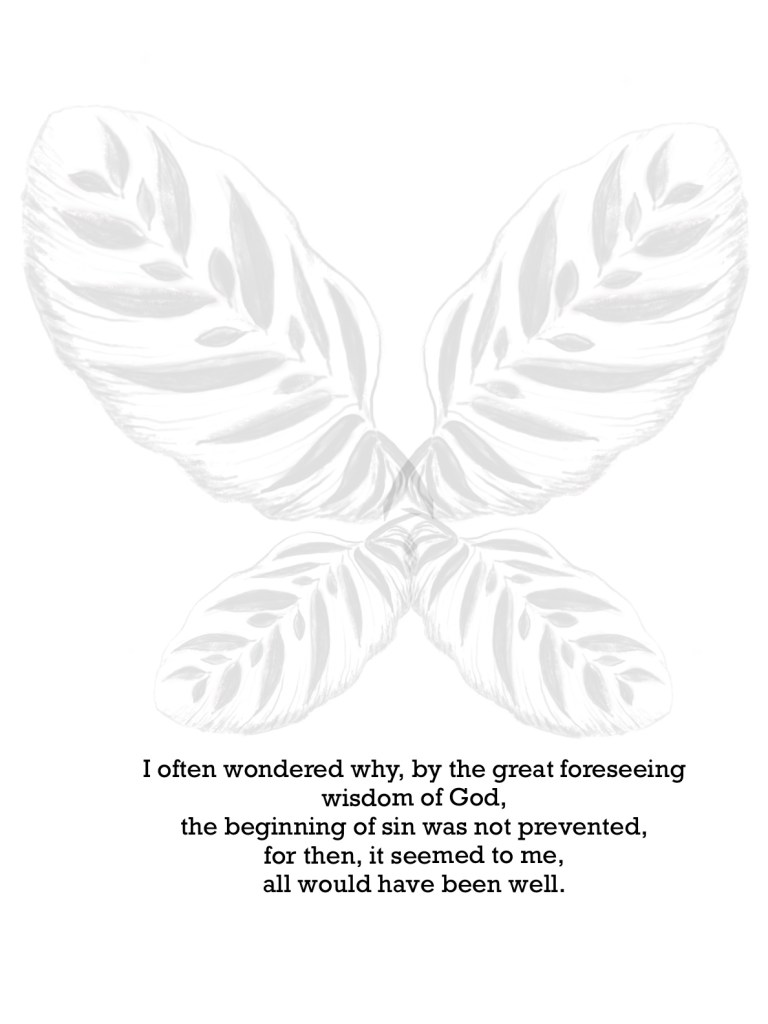
Julian asks God about wellness for the world more than once. How can things become well, when evil seems to permeate the world so thoroughly? Wouldn’t all have been well if sin had been prevented in the first place? Couldn’t God have thrown up an impenetrable barrier against it?
To accompany Julian’s question, I drew a single leaf from the peacock plant. Peacock leaves display a striking green and white pattern, as if painted. In my drawing I repeat the leaf in a symmetrical arrangement to symbolize what my own mind wishes for: perfection as symmetry, clean and free of blemishes or suffering. Julian longed for such innocence and worried hard over God’s reasons for allowing sin. “I ought much to have given up this disturbing wondering,” she admits ruefully, “but nevertheless, I made mourning and sorrow about it without reason or discretion.”
I’m glad the questions troubled her. They trouble me too. I will never forget one night in my young adulthood when, having learned of a Colombian baby born with a genetic abnormality that caused chronic pain, I tossed, turned, and wept in bed. The child was receiving tender care at my parents’ foster home, but still, how could a good God have allowed this? How could God ever make it up to little Diana?
You may well have endured a night like that. Or a day, or a week, or many months. You may be Diana, suffering incurable chronic pain.
How can all be well?
* * *
I was tempted to leave the question hanging and try to do justice to “all shall be well” in a later post. But I won’t. Here’s how I understand God’s response to Julian’s anguished cry.
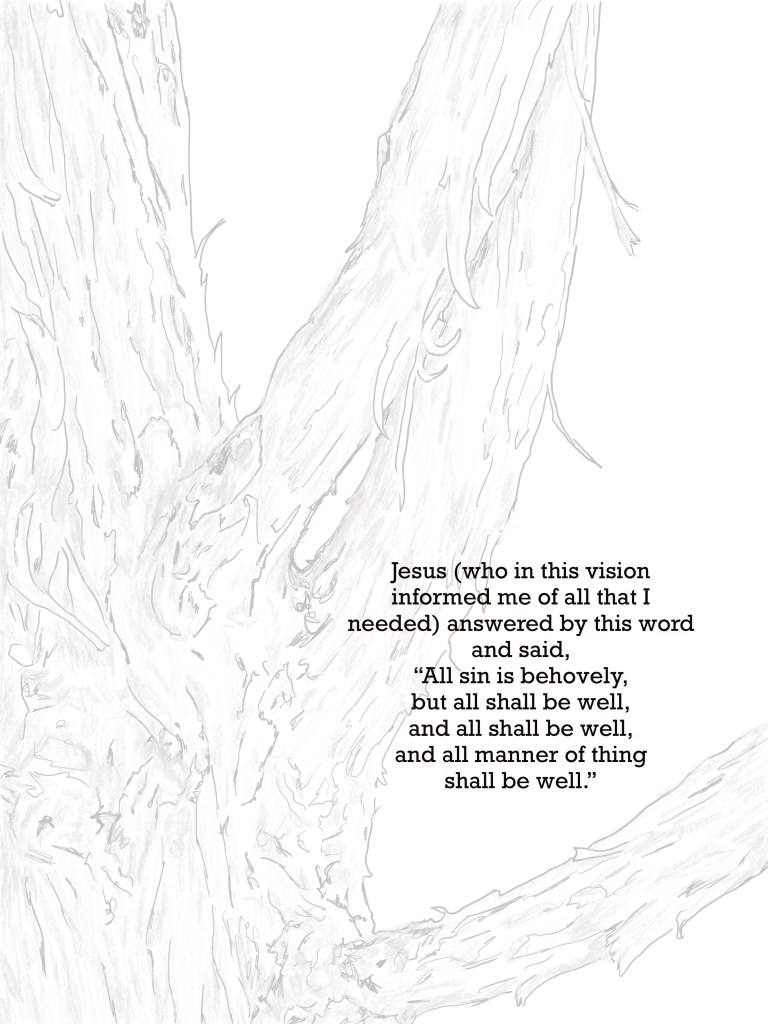
I chose to draw part of a bald cypress tree in late autumn to accompany the words Julian heard Jesus say. I think you’ll see why.
Jesus tells Julian that sin is “behovely.” I retained this Middle English word because there’s some discussion among translators about its meaning. The phrase “it behooves us to ____” incorporates a more recent version of the term: we need to do x, it is the right thing to do. Behovely could mean necessary. It could mean appropriate. The late Father John-Julian, whose Julian translation I’ve been adapting, chose inevitable here.
Jesus doesn’t answer the how-question directly, but he seems to be saying that sin (which has no being in itself but is parasitic on God’s good creation) is an occasion of something beautiful. Because of Adam and Eve’s fall, the Second Person of the Trinity fell into the creation and identified with its suffering, becoming the Child of Humanity. The story of God’s involvement with the world is still being told. It is a story of redemption, of movement toward shalom.
The Lord doesn’t say shalom, of course. Jesus uses Julian’s own word, well. I find it sweet that Mother God offers Julian this mirroring, the way a human mother repeats her toddler’s words to affirm them and maybe help the child to pronounce them clearly.
Julian has rebuked herself for her desperate struggle, but Mother God does not scold her. Quite the opposite.
Your desire is good, Mother God is saying. It is my very purpose. The promise is never conditional: indeed all shall be well—abundant, lacking nothing, satisfying.
* * *
Julian’s earlier showings include strange and gruesome visions of Jesus’s sufferings on the cross. I am not drawn to those images, but Julian found them marvelous and comforting. I think she was able to believe God’s assurances of wellness—well-being and restoration of all that is damaged—because she had seen Jesus suffering with us.
The healing of all things does not involve a magic wand. It’s not the detached action of a god who is playing a cosmic game. Jesus suffered damage just as we do. The need for things to be well is personal for Julian’s Lord.
The “when” that goes unvoiced in Julian’s question is implicitly eschatological, and another day I will write about her blazing insight into the Last Things. For now, let’s simply burrow into the promise.
All shall be well, and all shall be well. And all manner of thing shall be well.
Oh child, Mother God says. Your desire is not too much for me. You don’t even know how much and how many things need to be set right, to be brought into wellness. It is more than you can ask or imagine. I promise you, though, that restoration is for all. Not just for humans, not even just for creatures that breathe. Every kind of every thing shall be well.
If you want to explore Julian’s theology further, I highly recommend Amy Frykholm’s May 2023 article “Julian the Theologian.” And there are more writings and podcasts to check out on my Julian’s Porch page (see menu).
Sign up for my newsletter!
Processing…
Success! You're on the list.
Whoops! There was an error and we couldn't process your subscription. Please reload the page and try again.
I was walking home from a backyard birthday party in my neighborhood—the first festive gathering I had attended in person since the covid-19 pandemic restrictions had begun sixteen months earlier.
I had been snapping pictures of beautiful trees and an inspiring front yard with rhubarb, a cloud of dillweed, and a sign with a Wendell Berry poem planted near the sidewalk. I walked under the Metro train viaduct and saw him at the Clark Street intersection.
The man was white with graying hair, wiry, and deeply bowed at the waist. He was pushing a bike and had stopped to catch his breath.
When I caught up with him, I asked if he could use some help pushing his bike. He demurred but then said yes, so I took hold. It took him a little while to release his hold—I think he wanted to make sure it wasn’t too heavy for me. I too am graying. Once he realized I was OK with the weight, he let go. A heavy bag hung from the handlebars, and another was fastened behind the seat.
As we headed north on Clark, he told me that he was heading to his girlfriend’s apartment near the Mexican bakery up ahead. She had been bedridden for eighteen months; I didn’t catch her diagnosis. Her mother had died of covid in October 2020.
He himself had been attacked and robbed on the Red Line months ago. He had undergone surgeries but was left with a wracked body. He thanked me for accompanying him. “My name’s Will,” he said.
“And I’m Ruth,” I replied.
He pointed to a gangway to enter his girlfriend’s building, on the opposite side of Clark. I suggested that we continue to the corner to cross at the light, but he veered into the street midblock. North-south traffic was stopped or slowed by red lights at the moment, so I followed him and waved to drivers who made way for us.
At the narrow gangway opening, he insisted on taking the bike. I followed him to a locked gate that held a row of mailboxes. He unlocked it and I helped steady the bike as he squeezed through, ducking under the mailboxes. He didn’t want me to enter the building with him, even though he’d be hauling the bike up three flights of stairs. So I said goodbye and continued my walk.
* * *
All my life I have struggled to respond ethically to people in need in public places. I have been urged not to give to those who panhandle, as they may be feeding a drug habit. I have been urged to give them a small amount of cash and acknowledge their humanity. Some people advise offering only food as a way to flush out those who want cash for nefarious purposes.
I haven’t figured it out. I advocate for government programs that would provide housing and meet other needs. I give to food programs. But these initiatives have not yet provided everything that’s needed, so I still meet struggling people on the street sometimes.
Viaduct in my neighborhood
Given Jesus’s teaching in Matthew 25, I have realized that I must recognize Jesus in prisoners, sick folks, and others who suffer need and oppression. People don’t have to be virtuous and free of drugs to be Jesus to me. And I’m not their savior, just their sister.
Sometimes I give some money and say “God bless you.” Sometimes I have no money and can only smile at them and pray. Occasionally I stop to talk. My city is full of Jesus.
Will was not panhandling; he was pushing his bike along without asking for help. I got to be his sister for a few minutes, marveling at his determination, his willingness to walk bent over, struggling for breath, to reach his sick girlfriend. And then I had to respect his boundaries as he insisted that I go on my way while he somehow pulled his bike up the stairs alone.
* * *
One way that I process my grief at news of catastrophic floods and fires, intensifying effects of climate change, is to walk in my neighborhood as often as possible. I take many pictures of flowers, trees, the lake, the sky. Earth is sick “through our own grievous fault,” as the Book of Common Prayer confession says, so taking walks is a way of fulfilling Jesus’s parable of instruction: “I was sick and you visited me” (Matthew 25:36).
The whole earth is filled with God’s glory (Isaiah 6:3 and many other biblical passages). Given extreme economic inequities, pervasive effects of racism, and an oppressive criminal “justice” system, it is also filled with God’s suffering.
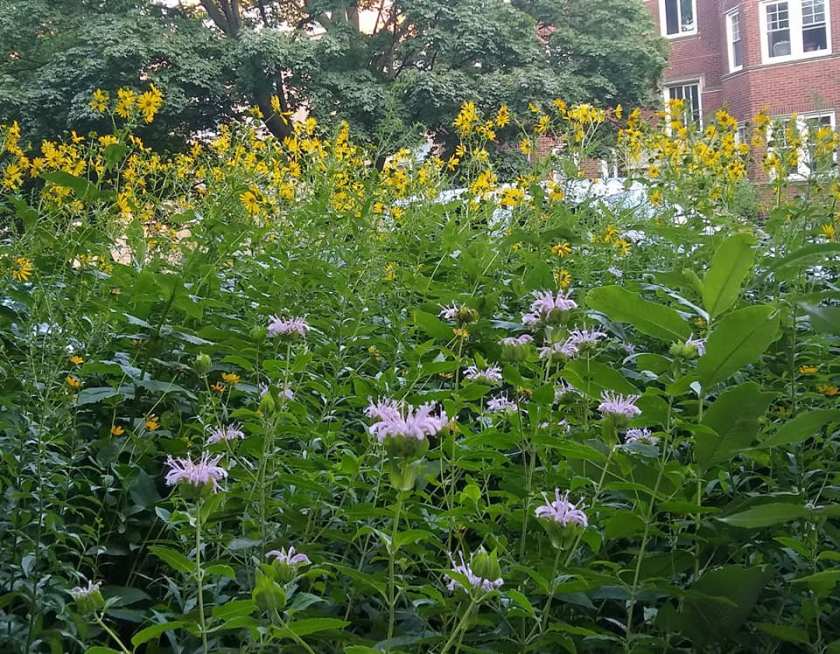
I want to be a friend who stays awake with Jesus in Touhy Park or crossing Clark Street. I want to keep my eyes open to Jesus’s presence in my neighbor’s riotous butterfly garden—cup plant and bee balm pushing toward the sun. And in the labored steps of a man named Will.





 Ruth Goring